
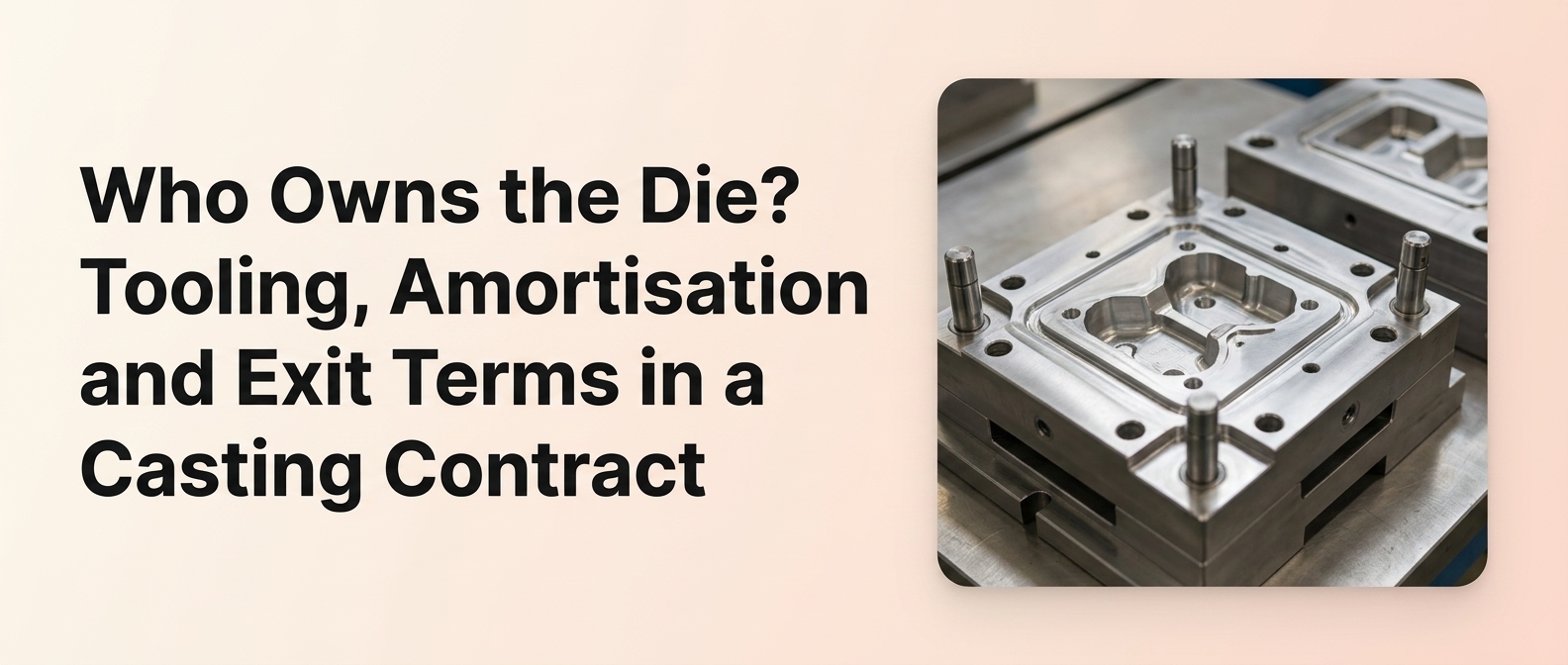
In 2026, choosing a supplier of die casting components is no longer only about piece price and capacity. Buyers now need clear tooling ownership, amortisation and exit terms in place before start of production, because that is when leverage is highest and continuity risk is lowest. This guide is a commercial decision framework for procurement, sourcing, supplier-quality, NPD and commercial teams evaluating die casting suppliers, not a “what is die casting” explainer.
Die ownership in a die casting contract is defined by the contract language, not by who paid. Ownership usually follows funding, but the supplier can still hold possession, control maintenance, and impose release conditions or a lien until balances are settled. Legal title, custody and release rights are separate and must each be written down.
Key takeaways
- Die ownership is defined by the contract, not by assumption – paying for the tool alone may not settle legal title or release rights.
- Amortisation spreads tooling cost across the part price, so the agreement should state the volume basis, timing and shortfall treatment upfront.
- Exit, transfer and tool release terms should be agreed before SOP, when the buyer still holds leverage.
- Maintenance, emergency repair, refurbishment and spare inserts need explicit cost allocation to avoid later disputes.
- A complete tool transfer includes more than the die itself; CAD, PPAP or sample records, maintenance logs, setup notes and inspection standards should move too.
- Legal title and possession are different: a supplier can lawfully hold a buyer-owned tool over unpaid balances if the contract permits a lien or retention of title.
Quick answer – who owns the die in a die casting contract?
There is no universal legal default that decides die ownership. Ownership is set by the tooling clause in the supply agreement, usually following who funded the tool, but the supplier can retain a contractual lien and control release, possession and maintenance. Payment alone does not automatically give you the right to remove the die.
The distinction that matters most is between legal title and practical control. A generic tooling agreement may state that all tooling paid for by the customer remains the customer’s property – yet the die caster still houses, operates and maintains it, and can hold it against unpaid invoices. That gap between owning and controlling is what the rest of this guide addresses.
Why tooling ownership should be settled before SOP
Tooling ownership should be resolved before the tool is approved and production begins, because that is the point at which buyer leverage is highest. Once the die is signed off, cavities are qualified and parts are shipping, the cost and disruption of re-sourcing shift negotiating power toward the incumbent supplier.
Vague terms create predictable downstream problems:
- Supplier lock-in – no clear transfer or release right, so moving the program means paying twice or cutting a new tool.
- Hidden double-payment – tooling recovered through piece price and again through a buyout, because the amortisation basis was never fixed.
- Release disputes – the supplier withholds the tool over disputed balances the contract never defined.
- Delayed re-sourcing – even a buyer-owned tool sits idle because documentation and spare inserts were never specified in the handover.
Red flag: if the contract is silent on ownership, or the default clause reads “the supplier owns all tooling unless otherwise stated,” treat it as a commercial risk. Silence and supplier-default wording both shift control away from the buyer, regardless of who paid.
In a 2026 environment where dual-sourcing and supplier-switch resilience are common risk controls – the BCI Supply Chain Resilience Report 2023 found nearly 70% of organisations experienced at least one supply chain disruption in 2022 – tooling governance belongs in supplier selection, not in post-nomination cleanup.
4 common die ownership models in casting contracts
Most casting programs fall into one of four ownership models. Each shifts who pays, who controls the tool day to day, and who carries exit risk. Understanding which model you are in tells you what to negotiate.
Buyer-funded and buyer-owned
The buyer pays the full tooling cost upfront, usually as capital tooling on a separate invoice, and the contract assigns legal title to the buyer. This is the clearest ownership position.
- Possession still usually sits with the supplier, who houses and operates the die.
- Buyer controls high-level decisions – transfer, scrap, major refurbishment – subject to agreed release conditions.
Supplier-funded and supplier-owned
The supplier funds and retains ownership of the die, recovering the cost through the piece price. This reduces upfront cash outlay for the buyer.
- Use of the tool is often limited to the nominated program, with exclusivity implications.
- Buyer transfer rights are limited; moving the program may require a buyout or a new tool.
Amortised tooling
The tool cost is spread across the unit price over an agreed production volume or program life, rather than billed upfront. Ownership may sit with the buyer from day one (with a supplier lien until paid) or transfer only on completion of amortisation.
- Watch for double-payment risk if the basis is not fixed.
- Shortfall exposure arises if actual volume falls below forecast (covered below).
Shared-investment or buyout models
Buyer and supplier co-fund the tool, or the supplier funds initially with a defined path to buyer ownership. These hybrids lower upfront exposure while setting a route to eventual control.
- Residual value and buyout mechanics – valuation, timing, release – must be documented.
- Ownership transfers should be formalised in writing and reflected in the asset register.
Ownership model comparison table
The table below summarises how the four models differ across the dimensions procurement teams scan first. Treat these as typical commercial patterns, not legal certainties – the contract wording governs in every case.
| Ownership model | Who pays upfront | Where cost appears | Who owns tool at SOP | Who approves major maintenance | Exit risk | Best for |
| Buyer-funded, buyer-owned | Buyer | Separate tooling invoice | Buyer | Buyer (owner) | Low with clear release clauses | Strategic programs, dual-sourcing |
| Supplier-funded, supplier-owned | Supplier | Embedded in piece price | Supplier | Supplier | High; limited transfer rights | Short-run or lower-strategic programs |
| Amortised | Supplier (recovered over volume) | Per-unit amortisation charge | Buyer or supplier, per contract | Depends on title | Medium; shortfall and buyout exposure | Predictable-volume OEM programs |
| Shared-investment / buyout | Buyer and supplier | Split invoice plus unit price | Contract-defined; transfers on buyout | Per funding split | Low to medium with clear buyout terms | Long-running programs with staged ownership |
Read the table across the “exit risk” and “who owns at SOP” columns first – those two decide how easily you can move the tool later.
How tooling amortisation works in part pricing
Tooling amortisation is the practice of recovering dedicated tooling cost through the unit price of a part over an agreed production volume or program life, rather than billing the full cost upfront. The contract should state the recoverable cost, the recovery basis, and what happens if volume is missed.
Recoverable tooling cost typically includes design, fabrication, tryout, validation, transport, installation and launch support. On a volume basis, the per-unit charge is the recoverable tooling cost divided by planned volume, added to each shipment’s price. On a time basis, the cost is recovered over a fixed period regardless of volume, similar to depreciating an asset.
Upfront tooling vs amortised pricing
Upfront tooling means the buyer pays a separate capital cost and gains the clearest ownership position, at the expense of higher initial cash outlay. Amortised pricing smooths cash flow by folding the cost into the piece price, but can obscure the true tooling total and create residual obligations later. The trade-off is ownership clarity and long-term flexibility versus near-term cash and simpler MOQ economics.
What happens if forecast volume is missed
If actual volume falls short of forecast, the unrecovered tooling balance does not simply disappear – the supplier usually seeks settlement. Common mechanisms include:
- A lump-sum settlement of the outstanding balance at the end of a time-based amortisation period.
- A debit note or final invoice reconciling under-run volume at program end.
- Early-cancellation recovery, where termination for convenience triggers compensation for unrecovered tooling investment.
In practice: a shortfall clause often reads that if the agreed volume (or time) elapses before the tooling is fully recovered, the buyer settles the remaining amortised balance in one payment. This is practical guidance, not legal advice; confirm exact wording with counsel.
How buyout terms should work
A buyout clause defines how one party purchases the other’s remaining interest in the tool. It should specify the residual value method (net book value, agreed percentage, or unrecovered balance), the trigger and timing, the payment method, and release of the tool on settlement. Retention of title until payment protects the supplier while giving the buyer a clear route to ownership.
The exit terms every OEM buyer should negotiate before approving tooling
Exit terms should be written into the original contract, before quality, delivery or re-sourcing pressure forces a move. The following five clauses cover the situations that most often stall a transfer.
Tool release conditions
Release conditions define when the tool can leave the supplier’s facility. Confirm ownership in the tooling schedule, require settlement of tooling and part invoices to the release date, and set the tool’s condition standard on release.
- Address any residual amortisation balance before release.
- Clarify whether and when a supplier lien or retention-of-title right is waived.
Termination rights
Termination clauses should distinguish termination for cause from termination for convenience, because each carries different tooling consequences. Define notice periods, cure windows, and what happens to the tool on termination – return, buyout, or approved scrapping.
Transfer timing and notice
Set a notice period before the last production run at the incumbent, plus a defined transition window for packaging, transport and recommissioning.
- Reserve capacity at the incumbent during the handover.
- Agree a firm last-build date to avoid an open-ended transition.
Condition, packaging, freight and insurance
Specify the acceptable condition of the tool at handover, who crates and transports it, and who insures it in transit.
- Define when risk of loss passes between parties.
- Allocate liability and repair cost for any damage during handover.
Ongoing supply during transfer
Require the incumbent supplier to continue supplying parts up to a defined end date so production is not interrupted during the tool move. Agree bridge or end-of-life stock levels to cover the new supplier’s ramp-up.
Contract clause to ask for: “The tool, together with all associated spare inserts, CAD data, PPAP/sample records, maintenance logs and inspection standards, shall be released to the buyer or its nominated supplier upon settlement of undisputed balances and reasonable written notice.” This is practical guidance for your RFQ, not legal advice – confirm final wording with legal counsel.
Who pays for maintenance, repairs and spare inserts?
Maintenance responsibility should be agreed before production, separating normal wear, supplier negligence and buyer-driven engineering changes. Under common practice, the die caster covers routine care as caretaker, while the tool owner funds major repairs and refurbishment.
Normal wear and preventive maintenance
The die caster, as the party housing and operating the die, is typically responsible for routine preventive maintenance, minor repairs and day-to-day care – the work that manages release, controls scrap rate and preserves tool life across the expected cavity count.
Breakdown and emergency repair
Major repairs from normal wear usually fall to the owner and should be pre-approved, while breakdowns caused by supplier negligence or misuse are commonly assigned to the supplier. Define an approval process and a spend threshold for emergency repairs so work is not delayed by a cost dispute.
Engineering-change costs
Buyer-initiated design changes that alter the part or require new inserts or cavities are typically buyer-funded, captured as engineering-change tooling charges. Specify how revision control and any PPAP or sample re-approval are handled and paid for.
Refurbishment and end-of-life decisions
Refurbishment triggers – rising scrap rate, cavity wear, or an end-of-life assessment – should require owner approval and funding. Clarify ownership of spare inserts (often customer-owned even when a master holder is supplier-owned) and require approval before any tool is scrapped, along with treatment of residual scrap value.
| Cost event | Typical responsibility | What to confirm in contract |
| Routine preventive maintenance | Supplier (caretaker) | Scope and frequency of included care |
| Major repair from normal wear | Owner | Approval process and spend threshold |
| Repair from supplier negligence | Supplier | Definition of negligence vs wear |
| Engineering change | Buyer | Revision control and re-approval cost |
| Refurbishment / end-of-life | Owner | Approval, scrapping, spare-insert ownership |
What documents should transfer with production tooling?
A tool transfer is incomplete without its data package, and missing records are a common cause of delayed handovers. A transfer can fail even when ownership is clear if spare inserts, approval records and setup data are not part of the package. Plan the handover as die plus spare inserts plus the following records.
CAD/data and IP access
Transfer the 3D and 2D die design files and confirm access rights. Where the supplier designed the die, funding the tool does not automatically transfer CAD ownership – the contract must state whether the design is licensed to the buyer and can be shared with a new supplier.
PPAP or sample approval records
Move the dimensional reports, capability studies, material certifications and PPAP or sample approval history. This record proves the tool’s capability and speeds re-qualification at the receiving supplier.
Maintenance logs
Transfer the full history of preventive maintenance, repairs and refurbishment so the new supplier can assess tool health and plan future work.
Process / setup notes
Include machine settings, cycle parameters, release specifications and any special handling notes. Without these, ramp-up is slower and scrap rates can spike.
Inspection standards
Transfer drawings with tolerances, control plans and inspection procedures so quality expectations carry over unchanged.
How to compare die casting suppliers on tooling and exit terms
Instead of a “top suppliers” list, apply a consistent criteria framework to every shortlisted vendor. The clauses below are where tooling governance and exit risk are won or lost, and they let you compare a supplier of die casting components on more than price and lead time.
| Contract clause | Why it matters | Buyer-friendly wording to request | Supplier concern to address |
| Tooling ownership | Defines title, custody and transfer rights | Customer-funded tooling is and remains customer property | Clear liability and lien rights |
| Amortisation basis and shortfall | Drives cash flow and residual payments | Volume-based formula with defined shortfall treatment | Assured cost recovery on early exit |
| Maintenance and repair split | Prevents wear-vs-negligence disputes | Supplier covers normal care; owner funds major repair | Fair negligence definition |
| Release and transfer | Determines how easily the tool moves | Release on settlement, notice, full data pack | Protection against unpaid balances |
| Continuity of supply | Protects production during transfer | Incumbent supplies until a defined end date | Reasonable duration and volume limits |
If you’re the buyer: protect continuity and changeover flexibility by fixing ownership, amortisation basis and release conditions before SOP. If you’re the supplier: protect cost recovery and tooling control through clear lien, buyout and negligence terms. Balanced clauses reduce disputes for both sides.
Lamda Components brings an end-to-end die making, casting and machining perspective to this framework. Established in 1987, Lamda designs and builds dies in-house and runs them through pressure die casting and precision machining, which gives it a practical production view of how tooling clauses affect manufacturing outcomes.
Questions to ask a die casting supplier before approving tooling
Use this copyable list during RFQ and supplier evaluation, before you approve any tool.
- Who holds legal title to the tool, and is it recorded in a tooling asset schedule?
- What exactly does the tooling fee cover – design, fabrication, tryout, validation, transport?
- Is any cost amortised into the piece price, and on what volume or time basis?
- How is an amortisation shortfall settled if forecast volume is missed?
- Who funds routine maintenance versus major repairs and refurbishment?
- Who owns the spare inserts, and are they included in a transfer?
- What are the exact tool release conditions, and is there a lien over unpaid balances?
- What notice and transition window apply to a tool transfer?
- What documentation pack – CAD, PPAP or sample records, maintenance logs, setup notes, inspection standards – moves with the tool?
- Who packages, transports and insures the tool, and when does risk pass?
- Is the tool exclusive to our program, and is there an NDA in place?
- What are the end-of-life and service-parts obligations, including end-of-life stock?
How Lamda Components supports clearer tooling governance
Lamda Components Pvt. Ltd. is a Bangalore-based manufacturer and exporter established in 1987, specialising in aluminium die casting, precision machined components and die making. Its in-house tool room designs and builds dies, and its production runs end to end from casting through machining.
That end-to-end capability – tool design and development, aluminium die casting on machines from 250 to 800 tons, shot blasting, vibro deburring, resin impregnation, precision machining, leak testing, powder coating and sub-assemblies – is why Lamda can relate tooling clauses to how the tool actually performs in production. You can see the full production capability across our facilities. From a die maker’s viewpoint, spare inserts, setup data and approval records are often critical to a smooth transfer, which is exactly where a buyer’s continuity is exposed.
Lamda supplies OEM and industrial customers across automotive, electrical, electronics and engineering sectors in domestic and export markets, so handover documentation and transfer readiness sit alongside tooling manufacture and production.
Contact us -> https://lamdacomponents.com/contact
Frequently asked questions
Does paying for tooling automatically mean the buyer owns it?
Not necessarily. Payment alone may not settle ownership if the agreement is silent or the supplier retains rights tied to design input, unpaid invoices or specific contract terms. Ownership follows the tooling clause, so it must be stated explicitly rather than assumed from who funded the tool.
Can a buyer transfer tooling to another die casting supplier?
Usually only with clear ownership and release rights. Transfer typically requires settled balances, the tool in an acceptable condition, and inclusion of spare inserts, CAD data, approval records and maintenance logs. Without these, a transfer can stall even when legal title is undisputed.
What should a tooling ownership clause include?
It should state who owns, stores, insures and may use the tool; who approves and funds repairs; and when and how transfer can occur. It should also cover spare inserts, CAD data access, maintenance logs, release conditions and any lien over unpaid balances.
Who pays for die maintenance and repair?
Agree this before production and separate three cases: normal wear, supplier negligence and buyer-driven engineering changes. Typically the die caster covers routine maintenance as caretaker, while the tool owner funds major repairs and refurbishment. Explicit allocation avoids disputes later.
What is a tooling buyout clause?
It defines how one party purchases the other’s remaining interest in a tool. It should set the residual value method, the trigger and timing, the payment method, and release of the tool on settlement, so ownership transfers cleanly once the outstanding amount is paid.
What happens to tooling when a casting contract ends?
The tool is returned, transferred, retained under agreed conditions, or scrapped with approval. The contract should define notice periods, treatment of any final payment or residual balance, condition expectations, transport responsibility and the supporting documents that move with the tool.
Can the supplier hold the tool because of unpaid invoices?
Possibly, if the contract grants a lien or retention of title over unpaid balances. This is why release conditions and possession terms must be explicit – so both parties know exactly when the tool can be released and what must be settled first.
If the supplier designed the die, who owns the design files?
It depends on the IP and data-access terms. Funding the tool does not automatically transfer CAD or design ownership unless the contract says so. Confirm whether supplier-designed files are licensed to the buyer and can be shared with a new supplier.
