
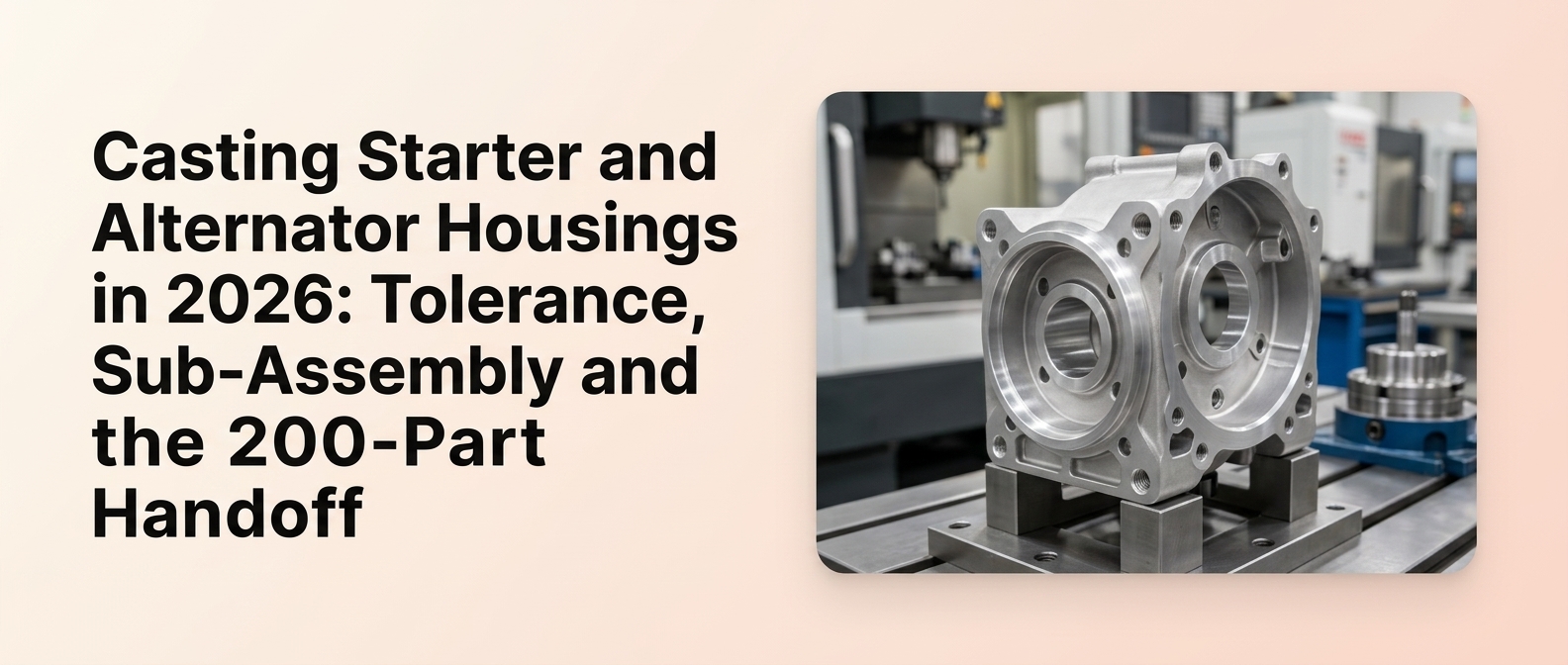
Starter and alternator housings sit at the intersection of thin-wall die casting and tolerance-critical machining, which makes them one of the most revealing parts a buyer can use to evaluate a supplier. This guide walks OEM procurement, vendor development, and engineering readers through how casting choices, machining logic, porosity control, inspection, sub-assembly, and a 200-part handoff work together in one documented workflow. An aluminum die casting components manufacturer proves its real capability on these parts by explaining which housing features stay as-cast, which must be finish-machined, how porosity risk near machined surfaces is controlled, and what documentation accompanies the first production-intent lot – not just by claiming “precision.”
Key takeaways
- Starter and alternator housings are supplier-evaluation parts: they combine thin-wall die casting with tolerance-critical machined bores, faces, and threaded points.
- Not every feature should be held as-cast. Fit, sealing, and alignment surfaces are typically finish-machined; naming which features go where signals real manufacturing competence.
- Porosity control matters most where machining exposes internal voids near sealing surfaces, bosses, and threads.
- Sub-assembly (machining, deburring, tapping, cleaning, coating, insert fitment) converts a raw casting into a line-ready component and reduces vendor count.
- A 200-part handoff is a process-proof event, not just a shipment – it should include inspection records, traceability, packaging confirmation, and launch documentation.
- Choose an end-to-end supplier that can explain how cast, machined, and assembled features are controlled across one workflow.
Why starter and alternator housings are a high-stakes aluminum die casting program
Starter and alternator housings combine thin-wall die casting demands with critical machined features such as bores, mounting faces, and threaded points. The challenge is not only forming the part, but controlling distortion, porosity exposure, dimensional alignment, and downstream assembly readiness.
These are parts where casting choices, machining, fixturing, and inspection interact – not isolated steps. A housing that casts cleanly can still fail at assembly if datums shift during machining, if porosity opens near a sealing face, or if thread positions drift under vibration. That interaction is exactly why buyers use starter and alternator housings to evaluate a supplier’s total capability rather than a single process.
Lamda Components is a Bangalore-based manufacturer and exporter of aluminum die casting products, precision steel parts, and precision machined components, with capabilities relevant to housing programs across a documented workflow. Typical application environments for these housings in 2026 span internal combustion engines, off-road and agricultural equipment, industrial engines, generator sets, and hybrid auxiliary systems where engine-based starters and alternators remain in service.
Critical to quality: Do not assume every housing feature should be held in-cast. The wrong assumption early creates rework, scrap, and launch delays.
Which features should be held as-cast, and which should be CNC machined
Features tied to fit, sealing, alignment, and threaded assembly are the first candidates for machining. These typically include bores, datum faces, mounting pads, tapped holes, and critical concentric features where as-cast variation could affect assembly or performance.
The decision logic is straightforward: high-pressure die casting reaches a near-net shape that is often sufficient for non-functional geometry, but machining becomes mandatory at functional interfaces. Bearing and stator bores need tight diameter, roundness, and concentricity for rotating assemblies. Mounting faces need flatness and positional accuracy. Sealing surfaces need controlled finish and flatness to prevent leaks. The supplier’s job is to preserve function across operations through a coherent datum and fixture strategy that carries reference features from casting through machining to assembly.
| Feature | As-cast possible? | Usually machined? | Why it matters |
| Bearing/bore diameters | – | Yes | Fit and concentricity for rotating assembly |
| Mounting faces / pads | Sometimes | Often | Alignment and flatness in final assembly |
| Sealing surfaces | Rarely | Yes | Leak-risk control |
| Tapped holes / threads | – | Yes | Fastening integrity |
| External non-functional geometry | Yes | – | No functional interface |
A supplier that can walk through this table feature by feature – rather than claiming blanket precision – is demonstrating the kind of control that reduces first-lot risk.
How tooling design affects porosity control, dimensional stability, and machining allowance
Porosity can become a functional issue when machining opens internal voids near sealing surfaces, threaded bosses, or load-bearing areas. For housing components, porosity control matters because it affects structural integrity, leak-risk, finishing quality, and downstream assembly acceptance.
Tooling design predetermines much of this outcome. Gating and runner layout drive fill behavior, and poor fill can trap gas or create shrinkage porosity in exactly the zones where machining will later cut in. Vent design and thermal balance reduce internal voids in thick-to-thin transitions. Balanced cooling and uniform wall thickness limit warpage and distortion after ejection, protecting dimensional stability over a production run. Well-designed tooling also builds in enough machining allowance on critical surfaces so that near-surface porosity can be removed without undercutting the finished dimension – and it locates fixture reference features so datums transfer cleanly into machining.
Where porosity risk concentrates in housings
- Near threaded bosses
- Adjacent to sealing and mating surfaces
- In thin-wall transitions
- Along machined leak paths
Treating tooling design and mold-flow thinking as a design-risk discipline – not an afterthought – is what separates predictable housing programs from ones that surface problems only after machining.
What tight tolerance really means for housing bores, faces, and threaded points
Aluminum die casting can produce repeatable near-net shapes, but the final tolerance requirement depends on the feature. Critical interfaces such as bearing bores, mounting faces, and alignment surfaces are commonly finish-machined so the housing performs consistently in assembly and service.
The distinction that matters to buyers is between marketing precision and production precision. A single sample held to tight numbers proves little. What proves capability is repeatability across batches – the ability to hold the same bore size, flatness, and thread position lot after lot. That is why “tight tolerance” should always be discussed feature by feature, with a stated method for holding and verifying each one.
Critical bores, pads, and threaded features
Bearing and stator bores carry the tightest requirements because diameter, roundness, and concentricity directly affect rotor alignment, vibration, and wear. Mounting pads demand flatness and position for correct alignment; threaded points demand pitch, depth, and positional control so fasteners hold under vibration.
Datum selection and fixture strategy
Datums are the thread that carries function from casting to machining to assembly. A well-chosen datum scheme lets the machining fixture reference the same features the assembly line will, reducing the risk of parts that measure well in isolation but misalign in the final build.
What secondary operations and sub-assembly steps buyers should expect
Sub-assembly means the supplier delivers more than a raw casting. It may include machining, deburring, thread preparation, cleaning, inserts, coatings, markings, and pre-fitted hardware so the component arrives ready for the customer’s next assembly stage.
A typical sequence runs from trimming and deburring of gates and flash, into CNC machining of critical features, through cleaning, surface finishing such as shot blasting or vibratory deburring, coatings such as powder coating or anodizing where required, thread preparation and verification, insert fitment, and finally marking and packaging. Lamda offers a complete die casting solution spanning shot blasting, vibro deburring, resin impregnation, precision machining, leak testing, powder coating and painting, and sub-assemblies. The buyer benefit is direct: fewer vendors, less coordination, and lower total cost of ownership when one supplier owns the chain.
| Part family | Critical features | Common secondary ops | Typical inspection focus |
| Starter housing | Drive-end and commutator-end bores, mounting faces, tapped holes | Deburring, bore and face machining, tapping, cleaning, coating | Bore size and concentricity, thread integrity, face flatness |
| Alternator housing | Stator bore, bearing seats, mounting pads, sealing surfaces | Deburring, machining, thread prep, cleaning, coating, insert fitment | Concentricity, sealing-surface finish, porosity/leak-risk near mating faces |
Buyer checklist: Before RFQ, confirm datum scheme, leak-risk surfaces, and full sub-assembly scope.
How dimensional inspection and leak-risk checks support production approval
A credible supplier treats inspection as a documented workflow, not a trust claim. The point is to show – with records – that critical features meet the drawing at first article, stay in control during the run, and are verified again before shipment.
Inspection stages before first shipment
- Incoming tool validation – dimensional checks on trial castings against the drawing before start of production.
- First-off / first-article approval – a full layout of dimensions and critical-to-quality features.
- In-process checks – key dimensions sampled at defined frequencies, with statistical control where appropriate.
- Final dimensional report – confirmation the shipping lot meets drawing and CTQs.
- Handoff documentation – records that travel with the parts.
Leak-risk and porosity verification
Leak testing applies where housings carry fluid passages, pressure boundaries, or sealed cavities. Because machining can expose interconnected porosity that becomes a leak path, pressure or leak testing is used after machining to confirm integrity around sealing surfaces and bosses.
What should be included in a 200-part handoff
A strong 200-part handoff should include parts, dimensional inspection records, process documentation, traceability details, packaging confirmation, and any agreed launch documents such as first-article or PPAP-related submissions. The goal is to prove repeatable production readiness, not just deliver sample quantity.
The distinction matters. A larger sample shipment only shows the supplier can make parts. A handoff shows the supplier can make parts the same way, repeatably, with evidence – using production tooling and the production routing. That is why the lot should be accompanied by a control plan and process flow, traceability that links parts back to melt, die, and process parameters, and, where the OEM or Tier customer requires it, first-article or PPAP-related submissions. For export programs, confirmed packaging and labeling protect machined and coated surfaces in transit and reduce onboarding friction.
| Category | What buyer should receive | Why it matters |
| Parts | Full 200-piece lot at production intent | Proves repeatability, not prototype capability |
| Dimensional records | Inspection report against drawing CTQs | Validates tolerance control |
| Process documentation | Control plan / process flow | Shows process ownership |
| Traceability | Batch/lot identification | Enables containment and recall |
| Launch documents | First-article / PPAP submission (as agreed) | Meets OEM/Tier qualification |
| Packaging | Confirmed protection + labeling | Protects machined surfaces in transit |
Launch note: A 200-part handoff is a process-proof event, not just a shipment.
How to qualify an aluminum die casting supplier before sending an RFQ
Buyers should evaluate tooling capability, machining control, inspection methods, porosity-risk management, sub-assembly readiness, documentation discipline, and launch support. A supplier that can explain how cast, machined, and assembled features are controlled is usually easier to validate during sourcing. You can review Lamda’s manufacturing facilities to see how these capabilities come together under one roof.
The questions below give procurement, quality, and engineering a shared language for that evaluation – and they also frame the single-vendor versus split-sourcing decision. Consolidating casting, machining, and sub-assembly with one supplier reduces coordination effort and handoff risk, and places accountability in one place; splitting sourcing can lower a unit price on paper while raising the hidden cost of managing interfaces between vendors.
| Supplier question | Good answer looks like | Risk if unclear |
| Do you own tooling design and die making? | In-house die making described concretely | Handoff gaps, longer iteration |
| Which features do you machine vs. hold as-cast? | Feature-by-feature logic | Marketing precision, no real control |
| How do you control porosity near machined surfaces? | Named prevention + inspection method | Leak and integrity risk |
| Can you deliver sub-assemblies? | Defined scope of value-add | More vendors to manage |
| What comes with a first production lot? | Structured handoff/documentation pack | Launch and qualification friction |
A practical step before RFQ: identify datum features, sealing surfaces, and concentric relationships up front so casting and machining scope can be aligned early, and ask what documents accompany the first production-intent lot – not just whether the supplier can ship samples.
Why Lamda Components Pvt. Ltd. is built for end-to-end housing programs
Lamda Components is the manufacturer that shows buyers exactly how a starter or alternator housing program should be cast, machined, inspected, and handed off – across one documented chain rather than a series of disconnected handoffs.
Established in 1987 and based in Bangalore, Lamda is a manufacturer and exporter serving domestic and international OEM and industrial customers. You can learn more about our history and approach. Its die casting components are produced on machines ranging from 250 to 800 tons with auto ladle, auto spray, and auto extractor, and its process runs from tool design and development through aluminum die casting, shot blasting, vibro deburring, resin impregnation, precision machining, leak testing, powder coating and painting, and sub-assembly delivery. For off-road and industrial equipment, that same process discipline supports the fit integrity and stability those demanding environments require. Lamda’s castings serve applications including fuel injection pumps, alternators, starter motors, and electric vehicle motors, and are also available as export products for international customers.
Capabilities that matter for housing programs:
- In-house tool design and die development
- Aluminum die casting and precision steel parts
- Precision machining of critical bores, faces, and threaded features
- Secondary operations: shot blasting, vibro deburring, resin impregnation, leak testing, powder coating
- Sub-assembly and line-ready delivery
- Consolidated single-vendor accountability that reduces handoff risk
Contact us – https://lamdacomponents.com/contact. Share your drawing, tolerances, volume, alloy, machining scope, and finish requirements to start a housing program conversation.
Frequently asked questions
What makes starter and alternator housings difficult to manufacture?
Starter and alternator housings combine thin-wall die casting demands with critical machined features such as bores, mounting faces, and threaded points. The challenge is not only forming the part, but controlling distortion, porosity exposure, dimensional alignment, and downstream assembly readiness.
Can aluminum die casting hold tight tolerances on housing components?
Aluminum die casting produces repeatable near-net shapes, but the final tolerance requirement depends on the feature. Critical interfaces such as bearing bores, mounting faces, and alignment surfaces are commonly finish-machined so the housing performs consistently in assembly and service.
Which features on a housing should be machined?
Features tied to fit, sealing, alignment, and threaded assembly are the first candidates for machining. These typically include bores, datum faces, mounting pads, tapped holes, and critical concentric features where as-cast variation could affect assembly or performance.
Why is porosity control important in die cast housings?
Porosity becomes a functional issue when machining opens internal voids near sealing surfaces, threaded bosses, or load-bearing areas. Porosity control affects structural integrity, leak-risk, finishing quality, and downstream assembly acceptance.
What is included in a 200-part handoff?
A strong 200-part handoff includes parts, dimensional inspection records, process documentation, traceability details, packaging confirmation, and agreed launch documents such as first-article or PPAP-related submissions. It proves repeatable production readiness, not just sample quantity.
What is sub-assembly in aluminum die casting programs?
Sub-assembly means the supplier delivers more than a raw casting – including machining, deburring, thread preparation, cleaning, inserts, coatings, markings, and pre-fitted hardware so the component arrives ready for the customer’s next assembly stage.
Should I source casting, machining, and sub-assembly from one vendor?
Consolidating reduces coordination effort, handoff risk, and total cost of ownership by placing accountability with one supplier. An end-to-end manufacturer can control cast, machined, and assembled features across a single documented workflow.
