
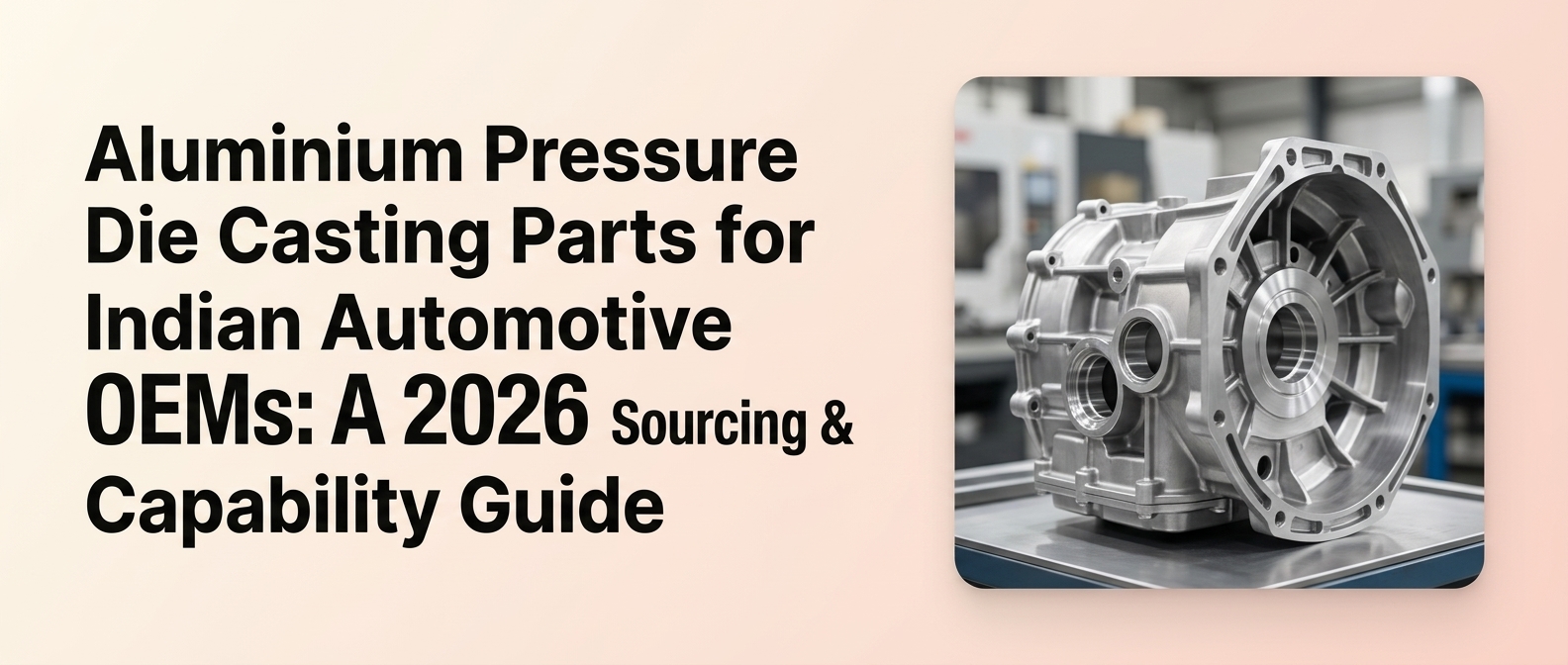
Indian automotive OEMs and Tier suppliers are consolidating their aluminium component spend toward integrated die casting partners that can move from drawing to dispatch under one roof. This guide is built for procurement, SQE, NPD, and program teams shortlisting an India-based supplier for high-pressure die-cast (HPDC) components in 2026. Aluminium pressure die casting is a high-volume manufacturing process in which molten aluminium is injected into a steel die under high pressure to produce dimensionally accurate, thin-walled, repeatable parts – making it a widely used route for automotive housings, covers, brackets, and EV enclosures where weight, tolerance, and cost per part all matter, drawing on well-established high-pressure die casting process fundamentals.
Key takeaways
- Aluminium HPDC injects molten aluminium into a steel die under high pressure to produce repeatable, thin-walled, dimensionally stable parts at scale.
- Indian OEMs commonly specify HPDC for gearbox and transmission housings, clutch housings, motor housings, pump bodies, brackets, covers, and EV enclosures.
- Common automotive die-casting alloys include ADC12 (general castability), A380 (strength and heat resistance), and LM24 (pressure-tight components).
- HPDC outperforms gravity die casting on thin-wall feasibility, cycle time, and cost per part at SOP volumes; gravity is better for lower-volume, thicker-section structural parts.
- Supplier evaluation should go beyond piece price to include in-house die making, machining integration, leak testing, inspection, and APQP/PPAP readiness.
- Lamda Components Pvt. Ltd., established in 1987 and based in Bangalore, offers integrated die making, aluminium die casting, and precision machining for OEM and export customers.
What are aluminium pressure die casting parts?
Aluminium pressure die casting parts are components produced by forcing molten aluminium into a hardened steel die at high pressure, then ejecting the solidified part once it has cooled. The process is engineered around high-volume, repeatable production, with the die – not the operator – controlling geometry, wall thickness, and surface finish across long production runs.
Definition (40–60 words): Aluminium pressure die casting (HPDC) is a manufacturing process where molten aluminium is injected into a steel die under high pressure to produce precise, repeatable parts at scale. It is widely used for automotive components requiring lightweight construction, tight tolerances, thin walls, and good as-cast surface finish.
Unlike sand casting (expendable mould, slower, rougher) or gravity die casting (mould filled by gravity, thicker walls), HPDC delivers tight dimensional accuracy and thin sections suited to modern vehicle architectures – including ICE powertrain enclosures and EV thermal and structural housings.
Why Indian automotive OEMs choose aluminium HPDC components
Indian OEMs are tightening targets on vehicle weight, assembly consistency, and landed cost per part – all while expanding EV programs alongside legacy ICE platforms, reflecting the Indian electric vehicle market growth outlook. Aluminium HPDC sits at the intersection of those priorities, which is why it is widely used for a growing range of housings, brackets, and enclosures.
Lightweighting for fuel efficiency and EV range
Aluminium offers a strong strength-to-weight ratio versus cast iron and steel, allowing OEMs to reduce mass on housings, brackets, and enclosures without compromising structural integrity. For EV programs, EV lightweighting strategies for range improvement across the body, drive unit, or battery enclosure supports range targets.
Repeatability for assembly line consistency
Steel dies and tightly controlled injection parameters produce parts with consistent dimensions shot after shot. This dimensional repeatability reduces fitment issues on OEM assembly lines, cuts rework, and stabilises downstream torque, sealing, and alignment operations.
High-volume production economics
HPDC cycle times are fast compared with sand or gravity casting, and well-built dies can support long production runs. Once tooling is amortised, cost per part stabilises at SOP volumes – which is exactly the economics OEM platforms need.
Corrosion resistance and thermal performance
Aluminium offers inherent corrosion resistance and good thermal conductivity, which matters for engine-adjacent components, inverter and motor housings, and EV thermal-management parts where heat must dissipate predictably.
Surface finish and reduced secondary operations
HPDC produces clean as-cast surfaces with controlled draft and minimal flash, reducing the machining stock required for non-critical faces. That trims cycle time, tool wear, and cost on downstream CNC operations.
Common automotive parts made by aluminium pressure die casting
HPDC fits automotive parts that combine complex geometry, thin walls, and high volume. The table below maps typical component families to why HPDC is the right route and the secondary operations usually involved.
| Component family | Typical OEM requirement | Why HPDC fits | Common secondary operations |
| Gearbox / transmission housings | Pressure tightness, dimensional stability | Repeatable thin-wall casting, complex internal geometry | CNC machining, leak testing |
| Clutch housings | Strength plus machined mating surfaces | Geometry complexity at volume | Machining, deburring |
| Motor housings (ICE and EV) | Thermal dissipation, concentricity | Heat conduction with repeatable bore geometry | CNC machining, impregnation |
| Pump housings | Leak-tightness | Porosity-controlled casting | Leak testing, machining |
| Brackets and covers | Lightweight, high volume | Cost per part economics | Shot blasting, powder coating |
| EV battery housings and enclosures | Lightweight, sealing, structural | Thin-wall structural geometry | Machining, surface treatment |
Did you know? HPDC is often preferred for automotive parts that combine thin-wall geometry with repeatable high-volume output – a combination that sand and gravity casting struggle to deliver economically. Common examples include aluminium housings used across powertrain and EV applications.
How the aluminium pressure die casting process works
The process is a controlled sequence – die, melt, inject, eject, finish – where the upstream decisions (gating, venting, alloy, parameters) determine whether the downstream part meets OEM specs.
1. Die design and cavity planning
Engineers design the steel die around the part geometry, gating, venting, draft angles, ribs, and ejection layout. This step sets feasibility for tight tolerances and porosity control before a single shot is fired.
2. Melting and injection
Aluminium is melted and held at a controlled temperature, then injected into the die cavity at high pressure and high velocity. Injection profile, shot speed, and intensification pressure all influence fill quality and porosity.
3. Solidification and ejection
The part solidifies inside the cooled die quickly. Cooling channels and cycle timing are tuned to balance throughput against distortion, with ejector pins releasing the part without damage to thin sections.
4. Trimming, deburring, and shot blasting
Flash, runners, and overflows are trimmed away. Vibro-deburring removes sharp edges, and shot blasting cleans the surface to prepare the part for machining, coating, or inspection.
5. CNC machining and final finishing
Critical bores, mating faces, threaded holes, and sealing surfaces are CNC machined to drawing tolerance. Where required, parts move on to resin impregnation, powder coating, or anodising.
6. Inspection, leak testing, and dispatch
Dimensional verification, visual checks, and leak testing (for pressure-tight parts) are completed before lot release. Traceability records support OEM quality escalation and audit needs.
Which aluminium alloys are used for automotive die casting?
Alloy selection depends on the component’s structural role, wall thickness, machining content, thermal duty, and pressure-tightness requirement. Many automotive HPDC programs in India work within a small set of established alloys.
| Alloy | Key characteristics | Typical automotive use |
| ADC12 | Good castability and fluidity, balanced mechanical properties | Housings, brackets, covers, general-purpose parts |
| A380 | Strength, heat resistance, good machinability | Engine-side components, transmission housings |
| LM24 | Good pressure-tightness and mechanical properties | Pump housings, sealed and pressure-tight components |
Pro tip: Lock in alloy selection before tooling kickoff. Wall thickness, machining stock, thermal duty, and pressure-tightness all influence the alloy choice – and changing alloys after die steel is cut is expensive.
How quality is controlled – porosity, leak testing, and dimensional accuracy
Automotive die-cast quality is engineered upstream and verified downstream. The most reliable suppliers treat porosity, leak-tightness, and dimensional accuracy as tooling-and-process problems first, and inspection problems second.
Porosity control
Porosity in HPDC is driven by gas entrapment, turbulence during fill, shrinkage, and inconsistent die temperature – well-documented die casting porosity causes and remedies. Controls span die design (gating and venting), process parameters (injection speed, pressure, die temperature), melt quality, and – where residual porosity remains in pressure-tight parts – resin impregnation to seal leak paths.
Common causes of porosity: turbulent fill, inadequate venting, low intensification pressure, gas pickup in the melt, inconsistent die temperature, and shrinkage in heavy sections.
Leak testing for pressure-tight parts
Housings, pump bodies, and sealed enclosures typically require leak testing – often air-decay leak testing methods or water-immersion methods – performed after machining. Acceptance limits are set against OEM drawings and validated through fixture-based testing.
Dimensional verification and CMM inspection
Post-machining, critical bores, faces, and GD&T features are verified using CMM dimensional inspection best practices and custom gauges. Sample plans, control charts, and lot-level records support PPAP submissions and ongoing capability monitoring.
Automotive quality frameworks
Indian automotive OEMs typically expect suppliers to operate against IATF 16949, the global automotive QMS standard built on ISO 9001, supported by APQP for launch planning and PPAP for part approval. Control plans, FMEAs, traceability, and customer-specific requirements (CSRs) round out the documentation expected at sourcing and SOP.
Did you know? Supplier evaluation for automotive die casting should include documentation readiness – APQP, PPAP, control plans, and traceability – not just casting capability. You can review Lamda’s manufacturing facilities to see how this is structured in practice.
Aluminium pressure die casting vs gravity die casting: which is right for your part?
The choice between HPDC and gravity die casting comes down to volume, wall thickness, cycle time, and tooling economics. The table below summarises how the two compare against machining from solid for context.
| Criterion | High pressure die casting | Gravity die casting | Machining from solid |
| Volume suitability | High (mass production) | Medium | Low to medium |
| Cycle time | Fast | Moderate | Slow |
| Surface finish | Good (as-cast) | Moderate | Excellent |
| Thin-wall feasibility | Strong | Limited | Not applicable |
| Tooling cost | Higher upfront | Lower upfront | None |
| Best-fit components | Housings, covers, brackets at volume | Lower-volume structural parts, thicker sections | Prototypes, low-volume precision |
When to choose HPDC: annual volumes justify steel tooling amortisation, the part needs thin walls or complex geometry, cycle time per part must be low, and dimensional repeatability is non-negotiable for assembly.
What to look for in an Indian aluminium die casting supplier
Supplier qualification for automotive HPDC is a multi-stakeholder decision. Procurement, SQE, NPD, and program teams all need confidence that one supplier can carry a part from DFM through PPAP without fragmented handoffs.
1. Lamda Components Pvt. Ltd. – end-to-end manufacturing since 1987
Lamda Components Pvt. Ltd. is a Bangalore-based manufacturer and exporter established in 1987, serving OEM and industrial customers across domestic and international markets. The company integrates die making, aluminium pressure die casting, precision machining, and precision steel parts within an end-to-end manufacturing setup – reducing vendor count, handoff risk, and the coordination overhead that typically slows automotive programs.
For Indian automotive buying committees, that integration matters in three ways:
- Tool control: in-house die making shortens iteration loops on DFM changes, tool corrections, and engineering revisions.
- Cross-process accountability: casting and machining sit with one supplier, so dimensional issues do not bounce between vendors.
- Geography: the Bangalore base places Lamda close to South India’s automotive and EV engineering ecosystems, supporting faster engineering reviews and audits.
2. In-house die making capability
Suppliers with captive tool rooms control die quality, lead time, and rework cycles. They can also feed casting feedback back into tool refinement quickly – a major advantage during APQP and tryout phases.
3. Integrated machining and finishing
Casting alone is rarely enough for an OEM-ready part. Look for CNC machining, deburring, shot blasting, and finishing under the same roof or through tightly managed partners, so parts ship assembly-ready.
4. Automotive quality system maturity
IATF 16949 alignment, APQP discipline, PPAP submission experience, and customer-specific requirement handling are baseline expectations. Ask for evidence – control plans, PFMEAs, sample PPAP packs – not just claims.
5. Documented inspection and leak testing capability
Pressure-tight components need defined leak-test methods, fixtures, and acceptance criteria. Dimensional control should be backed by CMM, gauges, and lot-level records traceable to specific production and machining batches.
6. RFQ responsiveness and DFM feedback
A good supplier returns a DFM review with the quotation – flagging draft, wall thickness, gating, and machining stock concerns early. That responsiveness is the single best predictor of program execution quality.
Supplier evaluation checklist
| Capability | Why it matters | Verify with |
| In-house die making | Tool control, faster iteration | Plant visit, capability deck |
| Aluminium HPDC | Core process | Machine tonnage range, shot weight |
| CNC machining | Assembly-ready parts | Inspection reports, machining list |
| Leak testing | Pressure-tight components | Test method, fixture documentation |
| APQP/PPAP support | OEM launch readiness | Sample PPAP pack |
| Traceability | Quality escalation control | Lot-level records, control plans |
What to include in an RFQ for aluminium die-cast automotive parts
A complete RFQ accelerates quotation, sharpens DFM feedback, and prevents costly re-quotes after tooling kickoff. Share these inputs upfront:
- 2D drawing with GD&T
- 3D CAD file (STEP or IGES)
- Material or alloy specification (or preference)
- Annual volume and expected lifetime volume
- Critical-to-quality features and tolerances
- Surface finish and cosmetic requirements
- Secondary operations required (machining, coating, assembly)
- Leak-test or pressure-tightness requirements
- Inspection plan and PPAP level required
- Packaging and delivery expectations
- Target SOP date and tooling timeline
Pro tip: RFQs that arrive with drawings, CAD, volume, and leak-test requirements together move through DFM and quotation noticeably faster than fragmented submissions. You can submit yours through the enquiry form.
Why Lamda Components Pvt. Ltd. for aluminium die casting
Lamda Components is positioned for Indian automotive OEM and Tier supplier programs that need an integrated die casting partner rather than a single-process vendor.
- Established 1987: nearly four decades of manufacturing continuity in aluminium die casting and precision machining.
- Bangalore base: proximity to South India’s automotive and EV engineering corridors, supporting engineering reviews, audits, and logistics.
- End-to-end capability: in-house die making, aluminium pressure die casting, precision machining, and precision steel parts – under one accountable supplier.
- OEM and export orientation: serving domestic OEMs and international export customers, with manufacturing discipline aligned to export quality expectations.
- Cross-process insight: experience across casting, machining, tooling, and off-road vehicle accessories gives engineering teams a broader DFM lens.
Discuss your component with Lamda’s engineering team – Contact us.
Frequently asked questions
What is aluminum pressure die casting?
Aluminum pressure die casting is a manufacturing process in which molten aluminium is injected into a hardened steel die under high pressure and held until solidified. The result is a dimensionally accurate, thin-walled, repeatable part – well suited to high-volume automotive components such as housings, covers, and brackets.
What are the advantages of aluminium die casting parts for automotive use?
Aluminium die casting parts are lightweight, dimensionally repeatable, and economical at scale. The process supports thin walls, complex geometry, and good as-cast surface finish, reducing both vehicle mass and downstream machining. For OEM assembly, repeatability improves fitment consistency, while aluminium’s corrosion resistance and thermal conductivity suit ICE and EV components.
Which aluminium alloys are used for automotive die casting?
The most common automotive HPDC alloys are ADC12, A380, and LM24. ADC12 offers good castability for general-purpose housings and brackets. A380 provides strength and heat resistance for engine-side and transmission components. LM24 is favoured for pressure-tight parts such as pump housings. Final alloy choice depends on wall thickness, machining, and thermal duty.
What is the difference between pressure die casting and gravity die casting?
Pressure die casting injects molten aluminium into a steel die under high pressure, supporting thin walls, fast cycle times, and high-volume production. Gravity die casting fills the die by gravity alone, suiting thicker-walled, lower-volume parts with lower tooling cost. HPDC typically wins on cost per part at SOP volumes; gravity wins on tooling economics for smaller runs.
What automotive parts are commonly made by aluminium HPDC?
Common HPDC automotive parts include gearbox and transmission housings, clutch housings, motor housings for ICE and EV applications, pump housings, brackets, covers, and EV battery enclosures. These components share the same characteristics: complex geometry, thin walls, dimensional repeatability requirements, and volumes that justify steel tooling investment.
How is porosity controlled in aluminium die casting?
Porosity is controlled primarily through die design (gating and venting), process parameters (injection speed, intensification pressure, die temperature), and melt quality. Stable die thermal profiles and clean melts reduce gas and shrinkage porosity. For pressure-tight parts with residual porosity, resin impregnation seals leak paths, followed by leak testing to validate the final part.
What quality standards apply to automotive die-cast parts in India?
Indian automotive die-cast suppliers are typically expected to operate against IATF 16949, the global automotive QMS standard built on ISO 9001. Programs are governed by APQP for launch planning and PPAP for part approval, supported by control plans, PFMEAs, traceability, and customer-specific requirements set by each OEM or Tier customer.