
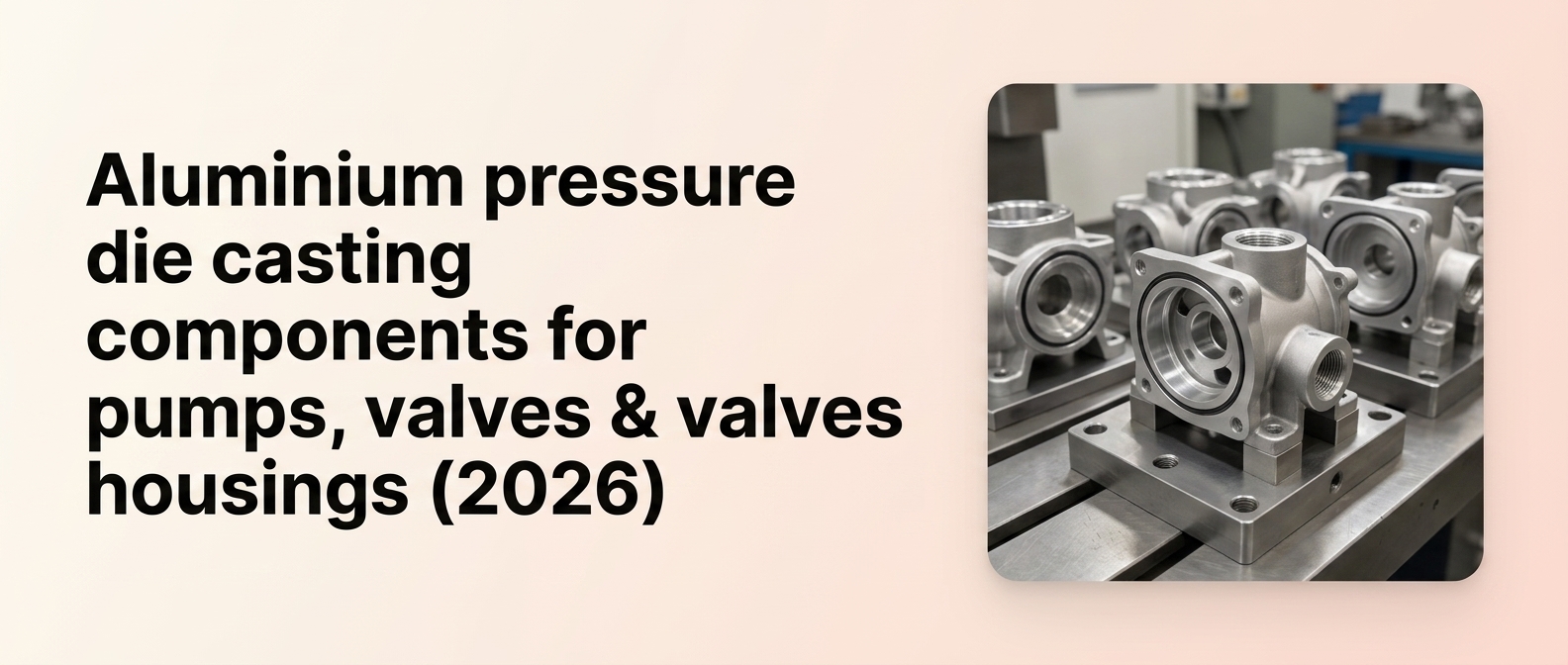
Selecting a manufacturing route for pump housings, valve bodies, and industrial enclosures forces engineers and procurement teams to balance weight, pressure tightness, geometry, repeatability, and unit cost in a single sourcing decision. Aluminium pressure die casting components are produced by injecting molten aluminium alloy into a hardened steel die under high pressure, rapidly solidifying into near-net-shape parts with good dimensional accuracy, fine surface finish, and high repeatability – making the process well suited to pump housings, valve bodies, motor housings, and industrial enclosures in medium-to-high volumes. This guide explains what the process is, why it fits fluid-handling and enclosure components, how it compares with gravity die casting and CNC machining, and what to share in an RFQ.
Key takeaways
- Aluminium pressure die casting (HPDC) injects molten aluminium alloy into a hardened steel die under high pressure to create repeatable, near-net-shape components.
- It is commonly used for pump housings, valve bodies, motor housings, and industrial enclosures that need dimensional consistency and efficient high-volume production.
- Buyer benefits include thin-wall capability, good surface finish, strength-to-weight ratio, corrosion resistance, and reduced secondary machining.
- For pumps and valves, pressure tightness and porosity control must be treated as design, process, and inspection priorities – not a single machine setting.
- HPDC, gravity die casting, and CNC machining each suit different geometry, pressure, and volume scenarios.
- Lamda Components Pvt. Ltd., established in 1987 in Bangalore, offers integrated die casting, precision machining, and value-added operations for OEM aluminium die cast components.
What is aluminium pressure die casting?
Aluminium pressure die casting is a manufacturing process in which molten aluminium alloy is injected into a hardened steel die under high pressure, rapidly solidifies, and is ejected as a near-net-shape component with consistent dimensions, fine surface finish, and complex geometry suitable for high-volume production.
The full cycle covers melting and metering of the aluminium alloy, high-velocity injection into the die, controlled solidification under intensification pressure, ejection of the casting, and trimming of runners and overflows. The steel die itself is a long-life production asset, amortised across thousands or millions of shots.
Why “high pressure” matters for component quality
High injection pressure forces the molten metal into every feature of the die before solidification, which is what enables:
- Thin wall sections and complex internal geometry in a single shot.
- Tight dimensional repeatability across long production runs.
- Good as-cast surface finish, reducing downstream machining and finishing.
For OEM buyers, this translates into lower per-part cost at volume, consistent fit and function, and predictable quality.
Why aluminium is used for pump, valve & housing components
Aluminium is a widely used casting material for industrial pump housings, valve bodies, and enclosures because it combines low density, useful strength, corrosion resistance, and excellent castability into thin and complex shapes. It also machines cleanly and accepts a wide range of surface treatments.
| Property | Why it matters for pumps, valves & housings |
| Strength-to-weight ratio | Lighter than steel or brass at comparable stiffness, helping reduce assembly weight and shipping cost. |
| Corrosion resistance | Natural oxide layer plus coatings makes aluminium suitable for many fluid and industrial environments. |
| Thermal conductivity | Supports heat dissipation in motor housings, drives, and electronics enclosures. See thermal conductivity of cast aluminium alloys for typical values. |
| Castability | Aluminium-silicon die casting alloys (such as A380/ADC12-type) flow well and support thin walls and complex features. |
| Dimensional stability | Maintains tolerances on bores, sealing faces, and mounting features after machining. |
| Machinability & finishing | Machines cleanly and accepts powder coating, anodising, painting, and impregnation. |
Common alloy families used in this segment include A380/ADC12 aluminium-silicon alloys, selected for the balance of castability, mechanical strength, and corrosion resistance demanded by pump and valve applications.
Components commonly made using aluminium die casting
Aluminium pressure die casting is widely used for OEM components that require complex geometry, low weight, and repeatable quality at volume – including pump housings, valve bodies, motor and gearbox housings, industrial enclosures, covers, brackets, and fluid-handling parts for sectors such as fuel injection pumps, alternators, EV motors, hydraulic equipment, and pneumatic products. Browse the full range of die cast products to see representative components.
Aluminium die cast pump housings
Pump housings are a natural fit for HPDC because they combine complex internal geometry, mounting bosses, port arrangements, and sealing surfaces – all of which can be cast near-net-shape. Bores, sealing faces, and threaded ports are then finished by CNC machining to the required tolerance.
Buyer tip: define sealing surfaces, bore tolerances, and threaded port locations early so that machining allowance can be designed into the casting from the start, avoiding rework loops.
Aluminium die cast valve bodies
Valve bodies depend on pressure tightness, accurate port geometry, and reliable sealing seats. HPDC delivers the complex external and internal geometry; porosity control and downstream pressure testing confirm the part is fit for fluid service.
Buyer tip: state your pressure-test or leak-test method, test pressure, hold time, and acceptable leak rate upfront – do not assume every die casting is leak-tight by default.
Aluminium die cast industrial & motor housings
Motor housings, gearbox housings, EV motor casings, drive enclosures, and equipment covers benefit from aluminium’s heat dissipation and its ability to cast in fins, ribs, and mounting features. Examples include aluminium housings and control housings produced for OEM applications, which reduce part count and post-casting operations.
Buyer tip: for thermally loaded housings, evaluate ribbed or finned external geometry during design – they can be cast in directly and often outperform bolt-on heat-sink solutions.
The aluminium pressure die casting process (buyer’s view)
For OEM buyers, the value of each process step is best understood by its impact on cost, lead time, and part quality.
- Die design & tooling – Tooling investment, lead time, and die life are set here. Good gating, venting, and cooling design also drive porosity control and dimensional stability.
- Alloy melting & preparation – Alloy choice (for example A380/ADC12-type) affects strength, corrosion resistance, machinability, and pressure tightness.
- High-pressure injection – Injection speed and pressure govern fill behaviour, thin-wall capability, and as-cast surface finish.
- Solidification & ejection – Cooling control and intensification pressure influence shrinkage porosity, internal soundness, and dimensional consistency.
- Trimming, secondary machining & finishing – Trimming removes runners and overflows; CNC machining brings critical features into tolerance; shot blasting, vibro deburring, impregnation, powder coating, painting, or anodising complete the part. Lamda’s in-house manufacturing facilities cover each of these operations under one roof.
Near-net-shape casting reduces but rarely eliminates downstream operations – most pump, valve, and housing components need at least selective CNC machining and a finishing step.
Pressure tightness, porosity control & quality inspection
Yes, aluminium pressure die casting can produce pressure-tight pump and valve components when alloy selection, die design, gating and venting, process control, and inspection are aligned. Where micro-porosity remains a concern, resin impregnation is used to seal residual porosity and meet leak-test acceptance criteria.
How porosity is controlled in industrial castings
Porosity in HPDC comes from two main sources: gas entrapment during fast filling and shrinkage during solidification. Robust suppliers manage it through:
- Die design – gating, runners, overflow wells, and venting tuned to part geometry.
- Process parameters – injection speed, pressure profile, melt temperature, and die thermal balance.
- Alloy selection and melt quality control.
- Resin impregnation when residual porosity must be sealed for fluid-tight service.
Inspection and pressure testing for fluid-handling parts
Pump and valve castings typically need dimensional inspection on critical bores and sealing faces, visual inspection of cast and machined surfaces, and pressure or leak testing on finished components. Lamda supports leak testing for critical components; specific test method, pressure, and acceptance criteria are aligned with each project.
Quality tip: pressure tightness is a system outcome of alloy choice, die design, gating and venting, process control, machining, and inspection – not a value set on a single machine. Specify the leak-test method and acceptance criteria in your RFQ.
Pressure die casting vs gravity die casting vs CNC machining
The right process depends on geometry, pressure requirements, and production volume. Pressure die casting injects metal at high pressure for thin walls, complex geometry, and high-volume repeatability; gravity die casting fills the mould under gravity, suiting simpler and thicker parts at moderate volumes; CNC machining from billet offers the tightest tolerances and best pressure integrity but with higher per-part cost.
| Criterion | High pressure die casting | Gravity die casting | CNC machining from billet |
| Best for (part type) | Complex, thin-wall housings, valves, enclosures | Simpler, thicker parts; moderate complexity | Low-volume, tight-tolerance or pressure-critical parts |
| Typical production volume | Medium to high | Low to medium | Low; prototyping or specialist parts |
| Dimensional accuracy | High and repeatable | Good | Highest |
| Surface finish | Good as-cast | Moderate as-cast | Excellent on machined surfaces |
| Thin-wall capability | Excellent | Limited | Limited by geometry and cost |
| Pressure tightness | Good with process and impregnation | Often good due to slower fill | Highest from wrought material |
| Tooling cost | High (steel die) | Moderate | None or fixture only |
| Per-part cost at volume | Lowest at volume | Moderate | Highest |
| Lead time to first samples | Longer (tooling) | Shorter than HPDC | Shortest |
| Typical secondary machining | Selective | Moderate | Already machined |
For pumps, valves, and industrial housings produced at OEM volumes, HPDC is usually the most economical route once tooling is amortised; gravity die casting is a fit for simpler, thicker geometries at lower volumes; CNC from billet stays useful for prototypes, very low volumes, or features that demand the tightest tolerance.
What OEM buyers should evaluate in an aluminium die casting manufacturer
A robust shortlist looks past unit price and evaluates whether the supplier can carry a part from drawing to delivery without handoff risk. Suggested evaluation criteria:
- In-house die design and tooling support.
- Range of HPDC machines suitable for the part size envelope.
- Aluminium alloy capability and material traceability.
- In-house precision CNC machining for critical features.
- Value-added operations: shot blasting, vibro deburring, resin impregnation, powder coating, painting, sub-assemblies.
- Inspection and leak/pressure-testing capability for fluid-handling parts.
- Engineering responsiveness on DFM, tooling, and first-article samples.
- Experience with OEM, automotive, and export customers.
- Years in operation and process maturity.
Lamda Components Pvt. Ltd., established in 1987 in Bangalore, combines aluminium die casting, precision machining, and value-added operations into a single supply route for OEM aluminium die cast components – supplying domestic and international customers across fuel injection pumps, alternators and starter motors, EV motors, hydraulic and pneumatic equipment, textile and medical equipment, automotive, and industrial appliances.
RFQ checklist: what to share when quoting an aluminium die cast component
A complete RFQ shortens quoting cycles, reduces DFM iteration, and gives you a defensible cost comparison across suppliers. Share the following with your shortlisted manufacturers:
- 2D drawing with GD&T or 3D CAD file (STEP/IGES).
- Preferred or required aluminium alloy (or target mechanical/corrosion properties).
- Critical-to-function tolerances, sealing surfaces, and datum scheme.
- Pressure-tightness or leak-test requirements (method, pressure, hold time, acceptance criteria).
- Estimated annual volume and call-off pattern.
- Secondary machining requirements and machined features.
- Surface finish or coating requirements (shot blasted, powder coated, painted, anodised, impregnated).
- Required certifications, test reports, or qualification process (for example PPAP/ISIR).
- Target lead time, packaging, and delivery destination (domestic or export).
- Application context – pump, valve, housing, or other – and any field-failure modes you want to design against.
The more complete the package, the faster the engineering review and the more accurate the tooling and unit-price quote. You can submit details directly via the enquiry form to start the engineering review.
Why choose Lamda Components Pvt. Ltd. for aluminium die cast components
Lamda Components Pvt. Ltd. is a Bangalore-based aluminium die casting and precision machining manufacturer established in 1987, working with OEM and industrial customers in domestic and international markets.
Capability differentiators relevant to pump, valve, and housing buyers:
- Integrated manufacturing combining in-house aluminium pressure die casting and precision CNC machining with value-added operations such as shot blasting, vibro deburring, resin impregnation, leak testing, powder coating, painting, and sub-assemblies.
- Established 1987 – decades of experience supplying aluminium die cast and machined components to OEMs.
- Bangalore-based manufacturer and exporter serving fuel injection pumps, alternators and starter motors, EV motors, hydraulic and pneumatic equipment, textile and medical equipment, automotive, LED lighting, door closures, and electrical and household appliances.
- Engineering-led RFQ process with DFM feedback on alloy, geometry, machining allowance, and pressure-tightness strategy.
- Single-source accountability from die development through finished, tested parts.
Send your drawing and application details for a DFM review and quote: Contact us →
FAQs
What is aluminium pressure die casting?
Aluminium pressure die casting is a process in which molten aluminium alloy is injected into a hardened steel die under high pressure, rapidly solidifies, and is ejected as a near-net-shape component. It delivers good dimensional accuracy, fine surface finish, complex geometry, and high repeatability for medium-to-high-volume OEM production.
What components are made using aluminium die casting?
Aluminium die casting is widely used for pump housings, valve bodies, motor and gearbox housings, EV motor casings, industrial enclosures, covers, brackets, and fluid-handling parts. Typical sectors include fuel injection pumps, alternators and starter motors, hydraulic and pneumatic equipment, textile and medical equipment, automotive, and electrical appliances.
What is the difference between pressure die casting and gravity die casting?
Pressure die casting injects molten metal into a steel die under high pressure, enabling thinner walls, complex geometry, faster cycles, and tighter repeatability at higher volumes. Gravity die casting fills a permanent mould under gravity, suiting simpler, thicker geometries at lower-to-moderate volumes, with lower tooling cost but reduced thin-wall capability.
Can aluminium die casting produce pressure-tight pump and valve components?
Yes. Pressure tightness is achievable when alloy choice, die design, gating and venting, process control, and inspection are aligned. Where residual micro-porosity remains, resin impregnation seals it. Pressure or leak testing on finished parts confirms each component meets the agreed acceptance criteria for fluid service.
Is secondary machining always required after die casting?
Not always, but most pump, valve, and housing components need selective CNC machining on critical features such as bores, sealing faces, threaded ports, and mounting surfaces. Near-net-shape casting reduces total machining time and material waste, but tolerance-critical features are normally finished on a CNC machining centre.
How should I send an RFQ for a custom aluminium die cast component?
Share 2D drawings with GD&T or a 3D CAD file, alloy preference, critical tolerances, pressure-test requirements, estimated annual volume, secondary machining and finishing needs, certification expectations, and target lead time. Lamda’s engineering team will respond with DFM feedback, tooling lead time, and a unit-price quote.