
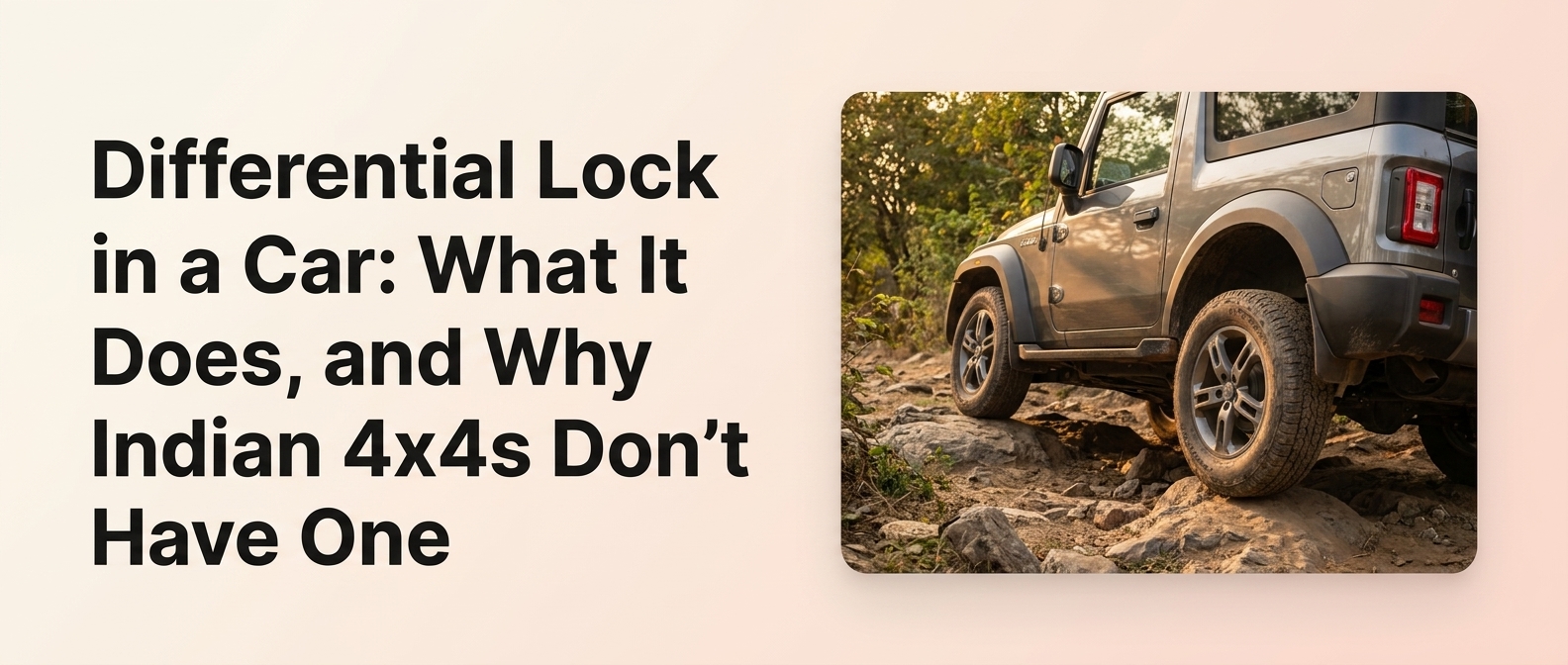
A differential lock is one of the most misunderstood traction tools on any 4×4. Owners routinely confuse it with 4WD, traction control, and various electronic systems, and many are unsure when to use it or whether their vehicle even needs one. This guide explains what it does in plain English and unpacks why many Indian 4x4s skip a true mechanical locker in favour of brake-based traction control.
Key takeaways
- A differential lock forces both wheels on the same axle to rotate at the same speed, restoring traction when one wheel loses grip.
- It is meant for low-grip surfaces only, such as mud, sand, deep ruts, loose rock, or when one wheel is in the air.
- Diff lock is not the same as 4WD; a vehicle can have 4WD without any locking differential.
- Never use diff lock on dry pavement because it can cause tire scrub, difficult steering, and possible drivetrain damage.
- Many Indian 4x4s rely on brake-based traction control instead of a mechanical locker for cost, packaging, and mainstream drivability reasons.
- A rear diff lock often offers the most practical value for serious off-road use in Indian conditions.
What is a differential lock in a car?
A differential lock is a mechanism that locks the left and right wheels on the same axle together, effectively forcing them to rotate at the same speed instead of at different speeds as they normally do. This restores traction when one wheel loses grip, because the wheel that still has traction can finally receive usable engine power.
In everyday driving, a differential deliberately lets your wheels spin at different speeds. That is helpful on the road but becomes a problem off-road, where an open differential can send power to the wheel with the least grip. A locking differential removes that weakness in specific low-grip situations. Lamda’s range of diff lockers is engineered specifically to solve this off-road traction problem.
How a normal (open) differential works
An open differential lets the inner and outer wheels spin at different speeds while still transmitting engine torque, which is essential for smooth cornering, a design principle behind how an open differential works in road cars. It is the default setup on most road cars and the baseline that a diff lock temporarily overrides.

[DIAGRAM: wheel-speed difference during cornering – outer wheel rotates faster than inner wheel]
Why wheels need to rotate at different speeds in a turn
When a car turns, the outer wheel travels a longer path than the inner wheel and therefore has to rotate faster. If both wheels were forced to turn at exactly the same speed, one tyre would have to slip across the surface. On dry pavement this causes tire scrub, heavier steering, and unnecessary stress in the drivetrain. The open differential exists precisely to allow this speed difference, which is why it is ideal for normal roads.
What an open differential does when one wheel loses grip
The catch is that an open differential tends to send torque to the wheel with the least resistance. If one wheel is in mud, on ice, or lifted in the air, that wheel simply spins while the wheel with grip receives very little usable torque. The result is a stuck vehicle even though one tyre still has usable traction. This is the exact scenario a differential lock is designed to solve.
What changes when you lock the differential
Locking the differential eliminates the open diff’s tendency to feed power to the spinning wheel. Once locked, both wheels on the axle must turn at the same speed, so the wheel with grip finally gets driven and can move the vehicle forward. In practical terms, this is what pulls a 4×4 out of situations where an open differential would leave it spinning helplessly.
Common confusion: Diff lock is not the same as 4WD. Locking the differential controls the left and right wheels on one axle. 4WD controls how power is split between the front and rear axles. A vehicle can have one without the other.
[DIAGRAM: open differential vs locked differential – torque behavior]
Open differential vs locked differential
The difference comes down to whether the axle allows a speed difference. An open differential permits it, which is perfect on-road but leaves you vulnerable when grip is uneven. A locked differential removes that speed difference, guaranteeing both wheels turn together so traction is shared based on what each wheel can actually use. One is built for smooth roads; the other is built for low-grip escapes.
Why a locked axle helps when one wheel is in the air
Axle articulation on rough terrain can lift one wheel off the ground entirely. With an open differential, that airborne wheel spins freely and takes the available drive, leaving the grounded wheel with almost nothing useful. Lock the axle, and the grounded wheel is forced to turn at the same speed as the lifted one, so engine power is finally delivered where there is traction. This is the single clearest demonstration of what a locker does.
Open differential vs locked differential vs traction control
The table below shows how the three most common traction approaches behave. Keep in mind that brake-based traction control mimics some of a locker’s effect but never mechanically locks the axle.
| System | What it does | Works when one wheel is in the air? | On-road suitability | Driver input needed |
| Open differential | Allows both wheels to spin at different speeds; shares torque | No – power goes to the spinning wheel | Excellent | None |
| Locked differential (diff lock) | Forces both wheels on the axle to turn at the same speed | Yes – grounded wheel still receives power | Poor; low-grip use only | Driver engages and disengages |
| Brake-based traction control | Brakes the spinning wheel to redirect torque to the wheel with grip | Partially, within brake limits | Good; works automatically | None |
When should you use diff lock?
Use diff lock only when traction is clearly low and you are moving slowly, engaging it before wheel spin turns into full loss of momentum. It is a traction-recovery tool for specific surfaces, not a mode for everyday driving. The following conditions are where it earns its place:
- Deep mud
- Loose sand
- Deep ruts and uneven terrain
- When one wheel is lifted (axle articulation)
- Loose rock and steep low-traction climbs
In each case, the goal is to keep both wheels driving so the vehicle can maintain slow, steady forward progress instead of digging in.
When should you NOT use diff lock?
Do not engage diff lock on dry, high-grip surfaces. When the axle is locked, both wheels are forced to turn at the same speed, but in a corner the inner and outer wheels need to travel different distances. On grippy pavement that mismatch has nowhere to go, so it shows up as tire scrub and driveline binding.
Warning: Do not engage diff lock on dry, high-grip pavement. Forcing both wheels to spin at equal speed while turning causes tire scrub, heavy steering, and driveline binding, which can lead to drivetrain damage under load or at higher speeds.
Avoid diff lock in these situations:
- Dry pavement and tarmac
- Tight turns on high-grip surfaces
- Normal city and highway driving
How to engage and disengage diff lock safely
Diff lock works best as a preventative aid at low speed, not a rescue button once you are fully bogged. Most modern e-lockers are designed to be engaged at very low speeds or when stationary; always follow your vehicle’s owner’s manual for exact requirements.
- Assess the surface – engage only on loose, slippery, or uneven ground.
- Slow to a near stop or very low speed, keeping the wheels roughly straight.
- Engage the locker via the button, switch, or lever as specified for your vehicle.
- Drive smoothly through the obstacle, avoiding sudden throttle inputs and tight turns.
- Disengage as soon as normal traction returns and before you return to higher-grip roads, to avoid driveline binding.
Is diff lock the same as 4WD?
No. 4WD sends power to both the front and rear axles, deciding which axles are driven. A differential lock makes both wheels on a single axle turn together, deciding how torque is shared left to right. These are separate systems, and a vehicle can have one without the other.
Diff lock vs 4WD
4WD is about front-versus-rear power distribution; a diff lock is about left-versus-right behaviour on one axle. Many 4WD vehicles run open differentials at both ends and add a rear differential lock or front differential lock only on off-road-focused variants. Having 4WD does not guarantee any locking differential.
Diff lock vs traction control
Brake-based traction control uses wheel-speed sensors and traction control to detect a spinning wheel, then applies the brake to that wheel so more torque is redirected to the wheel with grip. It imitates some locker behaviour but the axle itself stays open – nothing is mechanically locked. A true locker physically ties both wheels together so they always turn at the same speed, without relying on brake intervention. That mechanical difference matters most on extreme, low-grip obstacles.
Diff lock vs electronic limited-slip differential
A selectable e-locker is a true locking differential that switches between open and fully locked. An electronic limited-slip differential technology, by contrast, uses clutches and control logic to bias torque toward the wheel with grip while still allowing some speed difference. One fully locks the axle; the other only reduces slip.
What is an electronic differential lock (e-locker)?
A selectable electronic locking differential is a true locker that can be switched between open and fully locked modes using an electronic actuator, usually via a dashboard button or switch. When locked, both wheels on the axle are forced to turn at the same speed, just like any true locker.
It is worth being careful with terminology here. Some systems marketed as an “electronic differential lock” actually rely on brake-based traction control or clutch packs. These can improve traction and reduce wheel spin, but they do not always provide a full mechanical lock. A genuine selectable e-locker does.
Rear, front, and center diff locks – what’s the difference?
Not all lockers do the same job. A rear differential lock and front differential lock each control the left-right wheels on their axle, while a center diff lock ties the front and rear axles together. The table below summarises how they compare, followed by why rear lockers are the most common choice.
| Lock type | What it locks | Main benefit | Steering impact | Best terrain |
| Rear diff lock | Left and right rear wheels | Traction on climbs and ruts | Mild | Loose climbs, ruts, articulation |
| Front diff lock | Left and right front wheels | Maximum front-axle traction | Noticeable; can feel heavy | Slow, technical rock crawling |
| Center diff lock | Front and rear axles together | Prevents one axle spinning freely | Subtle | Mixed-grip surfaces, full-time 4WD |
Why a rear locker is more common than a front locker
When a front locker is engaged, both front wheels must turn at the same speed, which directly fights the different speeds needed for steering. The result is heavier steering and a stronger tendency for the vehicle to push straight ahead, especially on grippy ground. A rear locker acts on the axle that simply follows the steering, so its effect on steering feel is much milder. That is why rear lockers are generally the first choice for serious off-road use, with front lockers reserved for slow, technical terrain where the steering impact is acceptable.
Why many Indian 4x4s don’t come with a diff lock
In the current Indian SUV market trends and 4×4 segment, many mainstream models rely on brake-based traction control and electronic aids for everyday rough-road use, reserving mechanical cross-axle lockers for a smaller set of off-road-focused variants. This is a deliberate engineering and business trade-off rather than an oversight, driven by how buyers actually use these vehicles. As a manufacturer of off-road vehicle accessories, Lamda Components Pvt. Ltd. sees this decision play out across cost, packaging, and drivability.
India buying reality: Many Indian SUVs marketed as off-road capable use brake-based traction control rather than a true mechanical locker. Both aid traction, but only a locker mechanically forces both wheels to turn together.
1. Most buyers don’t do extreme off-roading
The typical Indian SUV buyer drives highways, city roads, and rough rural stretches far more often than technical trails. If the toughest surface you meet is a gravel road, a mechanical locker adds little to your daily reality, so demand for it stays limited.
2. Brake-based traction control covers most mild use cases
For gravel, mild monsoon slush, and uneven farm tracks, brake-based traction control paired with good tyres is often enough. It works automatically, requires no driver decisions, and handles the low-grip patches most owners actually encounter without any manual locking.
3. Locker hardware adds cost and complexity
A true locker is not just a switch. It requires an actuator, a robust locking mechanism, a reinforced housing, careful sealing, and precise machining to work reliably under load. From a manufacturing standpoint, each of those elements adds bill-of-materials cost and process complexity compared with a purely electronic, brake-based solution.
4. Packaging and system integration trade-offs
Axle and differential housings have to physically accommodate the locking hardware and its wiring. The locker’s behaviour also has to be calibrated alongside ABS and stability control integration and traction control so the systems do not work against each other. That integration effort influences whether a locker makes the cut.
5. On-road misuse is a customer-experience risk
A locker left engaged on dry pavement causes tire scrub, heavy steering, and driveline binding. For a mainstream audience unfamiliar with the system, that creates a real risk of misuse and potential drivetrain damage, along with warranty and satisfaction concerns that OEMs prefer to avoid.
6. A rear locker adds value mainly in specific terrain
The biggest gains from a rear locker appear in ruts, steep loose climbs, and moments when one rear wheel lifts. Many Indian buyers rarely face those extremes, which makes the feature genuinely niche rather than a broad, everyday benefit.
7. OEMs balance capability with mainstream drivability
Manufacturers tune these vehicles for predictable, comfortable behaviour across monsoon highways, dense traffic, and rural roads. Open differentials with brake-based aids deliver consistent steering and handling without asking the driver to manage a locker, which suits the mainstream buyer profile.
Who actually needs a diff lock in India?
A locker is a specialised tool, so the honest answer depends entirely on the terrain you regularly face rather than on marketing language. Use the framework below to judge whether it belongs on your build.
Probably yes if you regularly face:
- Serious trails with real wheel articulation where one wheel often lifts
- Deep sand or desert driving, such as dune driving in Rajasthan
- Rocky, low-traction climbs
- Overlanding or recovery-prone routes into remote areas
Probably not essential if you mostly:
- Drive on-road with occasional rough patches
- Handle farm tracks or mild monsoon slush
- Rely on good tyres, 4WD, low range, and traction control
Treat a locker as one part of a broader traction stack that includes tyres, low range, articulation, and recovery gear. For most drivers it is rarely the first upgrade needed; good all-terrain tyres, recommended tyre pressure for off-road driving, and sound technique usually deliver more than a locker for moderate use. If you drive a popular platform, Lamda offers vehicle-specific options such as the Mahindra Thar locker and the Maruti Jimny locker built for Indian terrain. For those chasing more ground clearance and gear reduction, our Jimny portal axles are another route to serious off-road capability.
Lamda Components Pvt. Ltd. is a Bangalore-based manufacturer, established in 1987, of precision components and off-road vehicle accessories serving OEM and industrial customers. For technical questions on differential lockers and off-road systems, Contact us – https://lamdacomponents.com/contact.
Frequently asked questions
Can diff lock damage your car on tarmac?
Using diff lock on dry tarmac forces both wheels to turn at the same speed in corners, causing tire scrub, heavy steering, and driveline binding. A single short misuse may not break anything immediately, but repeated or high-load use can contribute to premature wear or drivetrain damage.
Do you engage diff lock before or after getting stuck?
Engage it before traction is fully lost, ideally while stopped or moving very slowly on loose or slippery ground, at the first signs of wheel spin. It is a preventative aid at low speed, not a rescue button once you are fully bogged down at speed.
Does every 4×4 have a locking differential?
No. 4WD only means power can reach both axles; it does not guarantee cross-axle lockers. Many 4x4s use open or limited-slip differentials plus traction control instead.
Is an e-locker the same as an electronic limited-slip differential?
No. A selectable e-locker is a true locking differential that mechanically forces both wheels on the axle to turn at the same speed. An electronic limited-slip differential or brake-based system only biases torque or brakes a spinning wheel and may not fully lock the axle.
Can a locker compensate for poor tires?
No. A locker improves how torque is shared between wheels but cannot create grip where tyres lack it. Worn or road-biased tyres will still struggle on mud or sand. Good tread, the right tyre type, and correct pressure are fundamental; the locker only supports them.
Is traction control enough for mild off-roading in India?
For mild off-roading such as gravel roads, broken village tracks, and light monsoon slush, brake-based traction control with 4WD and low range is often enough, especially with decent tyres. However, it is not the same as a mechanical locker and may struggle where wheels lift or grip differences are extreme.