
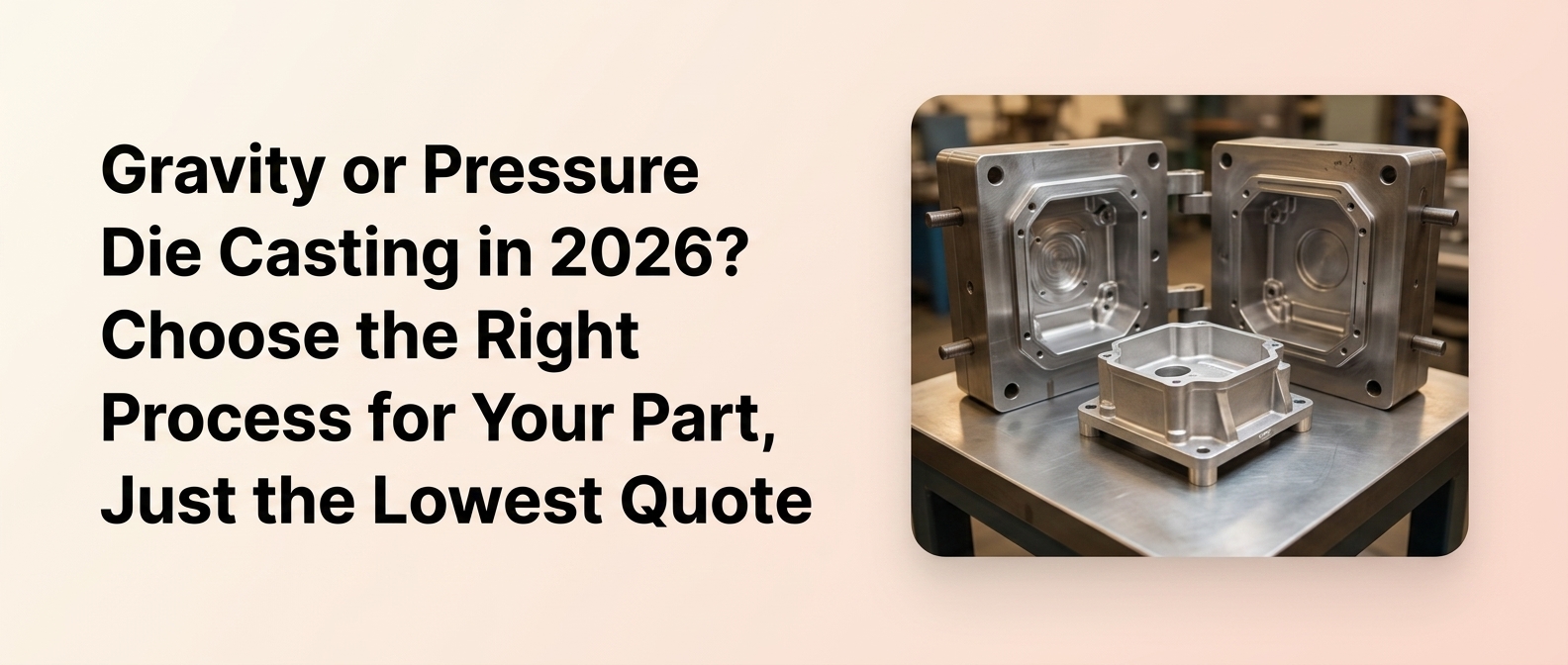
Choosing between gravity and pressure die casting is one of the most consequential early decisions in aluminum part development, yet buyers still make it based on a headline quote instead of what the part actually needs. This guide reframes the choice around geometry, alloy, mechanical properties, porosity sensitivity, and downstream machining so your part performs as intended and your total cost stays predictable.
Gravity die casting fills a reusable metal mold using gravity alone, while pressure die casting forces molten metal into the die under pressure. Gravity usually suits thicker, integrity-critical, often heat-treatable aluminum parts at small-to-medium volumes, while high-pressure die casting excels for thin-wall, tight-tolerance, very high-volume production.
Key takeaways
- Gravity die casting fills molds by gravity; pressure die casting forces metal in under pressure – each fits different part needs.
- Choose by part geometry, wall thickness, alloy, mechanical property targets, porosity sensitivity, and volume – not the cheapest quote.
- Gravity die casting often wins for heat-treatable, thicker-section, or integrity-critical aluminum parts.
- High-pressure die casting often wins for thin walls, high volume, and fast cycle times.
- The lowest piece-part price can raise total cost through machining, scrap, and rework.
- Evaluate a die casting facility on tooling, machining, heat treatment, inspection, and end-to-end capability – not process name alone.
Gravity vs pressure die casting: the quick answer
Gravity die casting pours molten metal into a reusable metal die that fills under gravity head alone, while pressure die casting injects metal into the die under force. Gravity favors thicker, integrity-critical, often heat-treated aluminum parts at small-to-medium volumes; high-pressure die casting favors thin-wall, tight-tolerance, very high-volume parts with fast cycles.
Choose gravity die casting when:
– Parts have moderate to thicker wall sections
– Heat treatment and high mechanical properties matter
– Internal soundness and controlled porosity are critical
– Volumes are small to medium and tooling budgets are constrained
Choose pressure die casting when:
– Walls are thin and uniform with long flow paths
– Volumes are very high and cycle speed is a priority
– Complex net-shape features reduce machining
– The tightest as-cast tolerances are required
The core rule holds throughout: pick by part, not by price.
What is gravity die casting?
Gravity die casting, also known as permanent mold casting, pours molten metal into a reusable metal die where it fills the cavity under gravity alone, without external pressure. The slower, less turbulent fill helps reduce air entrapment in many designs and can yield denser microstructures with good internal soundness when dies, gating, and process control are well engineered.
A typical gravity die casting process runs:
- Die preparation and coating
- Pouring molten metal into the cavity
- Solidification under gravity head
- Ejection of the casting
- Trimming and downstream operations
The outcomes buyers value most are a clean as-cast surface finish that often reduces finishing burden, better dimensional consistency than sand casting, and repeatability across small and medium series.
How gravity die casting differs from sand and pressure casting
Against sand casting, gravity die casting delivers better surface finish and dimensional consistency using a reusable metal die. Against high-pressure die casting, gravity uses no forced fill, so filling is slower and less turbulent with a different porosity behavior that can support heat treatment. Against low-pressure die casting, the difference is the fill mechanism: gravity relies on gravity head, while low-pressure pushes metal upward through a riser tube under controlled gas pressure.
How gravity, low-pressure, and high-pressure die casting differ
Use the table below as a decision tool rather than a rigid spec sheet. The right process depends on how these factors interact for your specific part, which is why qualitative fit matters more than any single headline number.
| Factor | Gravity die casting | Low-pressure die casting | High-pressure die casting |
| Fill mechanism | Gravity head, no external pressure | Controlled low gas pressure up a riser tube | High-pressure, fast plunger injection |
| Best-fit part geometry | Simpler, structurally critical parts | Structural, symmetric parts (e.g. wheels) | Complex, thin-wall net-shape parts |
| Wall thickness suitability | Moderate to thicker sections | Medium wall thickness | Thin, uniform walls, long flow lengths |
| Typical surface finish | Good, clean as-cast | Good, repeatable | Very good, often cosmetic-grade |
| Dimensional accuracy | Good repeatability, better than sand | High repeatability | Tightest as-cast tolerances |
| Porosity risk profile | Lower turbulence, denser structures | Controlled, low-turbulence filling | Higher gas entrapment risk |
| Heat treatment suitability | Well suited (e.g. T6) | Well suited for structural tempers | Often limited by porosity |
| Tooling cost (relative) | Lower | Higher than gravity, often below HPDC | Highest |
| Production volume fit | Small to medium | Medium to higher | Very high |
| Typical cycle time | Slower | Intermediate | Fastest |
| Secondary machining need | Depends on part | Depends on part | Often reduced by net-shape |
| Common alloys | Aluminum, zinc, brass | Aluminum (structural) | Aluminum, magnesium, zinc |
Choose by part geometry, wall thickness, and internal quality
Part geometry and internal quality requirements should lead the decision before volume or price enter the conversation. Thin-wall feasibility, section transitions, and how the part will be loaded in service tell you far more about the right process than an initial quote.
How wall thickness changes the process choice
Wall thickness is one of the strongest process drivers. Thin, uniform walls with long flow paths generally favor high-pressure die casting, which is built to fill those sections quickly and consistently. Moderate to thicker sections, or parts mixing wall thicknesses with structural intent, more often favor gravity die casting, where slower filling supports feeding and internal soundness. Because minimum wall figures vary by alloy, machine, and die design, confirm specific limits with your supplier against your actual geometry.
How porosity risk affects heat treatment and machining
Porosity is not a cosmetic concern – it directly affects whether a part can be heat-treated and machined reliably. Gas porosity and shrinkage cavities can expand during aggressive heat treatments like solution-treat and age, causing blistering and dimensional movement, which is why gravity and low-pressure processes are preferred for heat-treated structural parts. Porosity near machined surfaces also drives tool vibration, surface tearing, and breakthrough defects that increase scrap and rework. Under cyclic loading, pores act as crack-initiation sites that reduce fatigue strength.
Engineering note: Porosity and heat treatment are linked – process name alone does not guarantee integrity. Outcomes depend on die design, venting, alloy control, and inspection.
Choose by alloy, mechanical properties, and heat treatment needs
Alloy and process should be chosen together, not in sequence, because the alloy determines fluidity, achievable mechanical properties, and response to heat treatment. Gravity and low-pressure die casting are widely used for heat-treatable aluminum alloys in structural applications, where slower, controlled filling supports the denser structures those tempers demand. High-pressure die casting is common for aluminum, magnesium, and zinc in high-volume enclosures and moderately structural parts.
Broadly:
- Gravity die casting – aluminum (including heat-treatable grades), zinc, and brass
- Low-pressure die casting – aluminum, especially structural and symmetric parts
- High-pressure die casting – aluminum, magnesium, and zinc for high-volume parts
Machinability and final mechanical properties depend on both the alloy and how cleanly it was cast, so specify end-use conditions early and confirm the exact alloy at RFQ stage.
Choose by production volume, tooling, and cycle time
Volume matters, but it should refine a process decision that geometry and property needs have already shaped – not override it. High-pressure die casting dominates very high-volume programmes thanks to fast cycles and automation, and its higher tooling cost amortizes over long runs. Gravity die casting fits small-to-medium series where part integrity and heat treatment outweigh maximum throughput, with lower tooling cost as an advantage. Low-pressure sits in between for structural parts at medium-to-higher volumes.
Why production volume should not be your first filter
Leading with volume can push you toward a process that meets a throughput target but fails the part. A high-volume default like HPDC may not deliver the internal soundness a heat-treated structural part needs, while a low-volume assumption may ignore that a thin-wall design realistically only fills well under pressure. Establish geometry, wall thickness, and property targets first, then let volume tune the choice.
Why the lowest quote can cost more later
A lower piece-part or tooling price can quietly raise your total cost. If the chosen process leaves excess machining stock, higher porosity, or looser tolerances, you pay again in machining time, scrap, inspection, and rework – sometimes on every part, for the life of the program.
Red flag: Do not choose by tooling price alone. The cheapest quote can carry the most expensive downstream burden.
What to ask a gravity die casting facility before sending an RFQ
The process name on a quote tells you little about whether a facility can actually deliver your part reliably. Ask any casting facility these questions before you send an RFQ:
- Alloys and processes – Which alloys do you cast routinely, and do you run gravity, low-pressure, or high-pressure die casting?
- Tooling and die making – Do you design and build dies in-house, and how do you manage die maintenance over program life?
- Machining capability – What in-house machining do you offer, and how do you hold critical tolerances?
- Heat treatment and finishing – Do you manage heat treatment and surface finishing, and how is post-treatment distortion controlled?
- Inspection and quality control – What inspection methods do you use, including leak testing and porosity checks for integrity-critical parts?
- OEM and export readiness – Do you supply OEM and international customers, with the documentation and traceability that requires?
- Pre-RFQ engineering support – Will you review drawings and recommend a process before quoting?
What drawings and data to send for an accurate quote
An accurate quote needs more than a CAD file. Send:
- 3D CAD and a 2D drawing
- Tolerances and critical features
- Target annual volume
- Alloy preference or requirement
- Heat treatment and finishing needs
- End-use and loading conditions
Why secondary machining and finishing should shape process selection
Casting is one step in a chain: trimming, machining, heat treatment, finishing, and inspection all follow. The process that looks cheapest at mold fill can create the most downstream work, which is why secondary operations belong in the decision from the start. A part needing tight machined features and a controlled surface may justify a process choice that reduces stock removal or scrap, even at higher upfront tooling cost.
A typical downstream workflow runs:
- Trimming
- Machining
- Heat treatment
- Surface finishing
- Inspection
Each handoff between separate vendors adds a chance for dimensional drift, scheduling delay, and finger-pointing on quality. A single-source manufacturer that casts, machines, finishes, and inspects under one roof reduces those handoffs and keeps accountability in one place.
When gravity die casting is the better choice
Gravity die casting is often the better choice when internal quality and mechanical properties matter more than the thinnest possible walls or the fastest cycle. It tends to win for:
- Heat-treatable aluminum parts requiring specific tempers
- Integrity-critical or fatigue-loaded components
- Moderate to thicker or mixed wall sections
- Small-to-medium production volumes with constrained tooling budgets
- Functional parts needing repeatable machining
Common part families include aluminum housings, covers, brackets, and structural aluminum components – map these to your own part rather than assuming the fit.
When pressure die casting may be the better choice
Neither process is universally better, and high-pressure die casting is frequently the stronger answer for the right part. It tends to win for:
- Very high production volumes
- Thin, uniform walls with long flow paths
- Programs where fast cycle time is a priority
- Complex net-shape features that reduce machining
If your part is a thin-wall, high-volume enclosure with tight as-cast tolerances, pressure die casting often delivers better total cost than forcing a gravity approach.
When to avoid choosing by price alone
Price-first decisions ignore that total cost of ownership is built from many factors beyond the quote. Weigh these together:
- Tooling cost
- Scrap and porosity risk
- Machining burden
- Inspection effort
- Finishing requirements
- Rework probability
- Long-term reliability in service
A manufacturability review before pricing can help avoid scrap, rework, and inspection costs that no low quote offsets. A part that fails in the field or on the line is the most expensive part of all.
How Lamda Components supports end-to-end casting decisions
Lamda Components Pvt. Ltd. is a Bangalore-based manufacturer and exporter, established in 1987, that helps OEM and industrial buyers choose a process based on what happens before and after casting – not just at mold fill. Because die making, casting, machining, finishing, and inspection sit under one roof, the process recommendation accounts for the whole chain, not a single step.
Lamda’s die casting capabilities span an end-to-end workflow:
- Tool design, development, and in-house die making
- Aluminum die casting
- Precision machining and precision steel parts
- Shot blasting and vibro deburring
- Resin impregnation and leak testing
- Anodizing and powder coating
- Sub-assemblies
Castings from Lamda are used across sectors including fuel injection pumps, alternators and starter motors, electric vehicle motors, textile machinery, hydraulic and pneumatic equipment, off-road products, automotive, LED lighting, medical equipment, and electrical appliances. With domestic and international OEM experience, Lamda is a strong fit for buyers who need casting process selection backed by in-house tooling, machining, finishing, and inspection. Explore the full range of products and capabilities or view the facilities behind the process.
Send your drawing for a process recommendation
Before you compare quotes, get the process right. Send your drawing for a manufacturability review and alloy-and-process consultation, and let the decision be grounded in your part’s real geometry, properties, and downstream needs. Contact us – https://lamdacomponents.com/contact
FAQs
What is the difference between gravity and pressure die casting?
Gravity die casting fills a reusable metal mold using gravity alone, while pressure die casting injects molten metal into the die under high pressure. Gravity generally suits thicker, integrity-critical parts at small-to-medium volumes, and high-pressure suits thin-wall, tight-tolerance, very high-volume parts.
When should you choose gravity die casting?
Choose gravity die casting when you need heat-treatable or structurally critical aluminum parts with moderate wall thickness and controlled porosity, and are running small-to-medium volumes where lower tooling cost and internal soundness matter more than maximum throughput.
Is gravity die casting better than high pressure die casting?
Neither is universally better. High-pressure die casting leads for thin-wall, high-volume, tight-tolerance parts with fast cycles, while gravity die casting leads for integrity-critical, often heat-treated parts with thicker sections at moderate volumes. Selection depends on geometry, alloy, tolerances, and end use.
What parts are best suited for gravity die casting?
Gravity casting suits repeatable aluminum parts with moderate wall thickness and functional requirements – such as housings, covers, brackets, and other structural components – where mechanical properties and internal quality matter more than the thinnest possible walls.
Does gravity die casting reduce porosity?
Gravity casting’s slower, less turbulent filling can help control porosity compared with high-pressure casting, but actual internal quality depends on die design, venting, alloy control, and inspection. Process name alone does not guarantee low porosity.
How do I choose a gravity die casting facility?
Evaluate alloy and process capability, in-house tooling and machining, heat treatment and finishing options, inspection and leak testing, OEM and export experience, and whether the facility will review your drawings and tolerances before quoting. Learn more about us and our OEM export experience.
Is gravity die casting good for aluminum alloys?
Yes. Gravity die casting is widely used for aluminum alloys where repeatability, structural performance, and post-cast operations like heat treatment and machining matter. Choose the alloy and process together based on your part’s requirements.
