
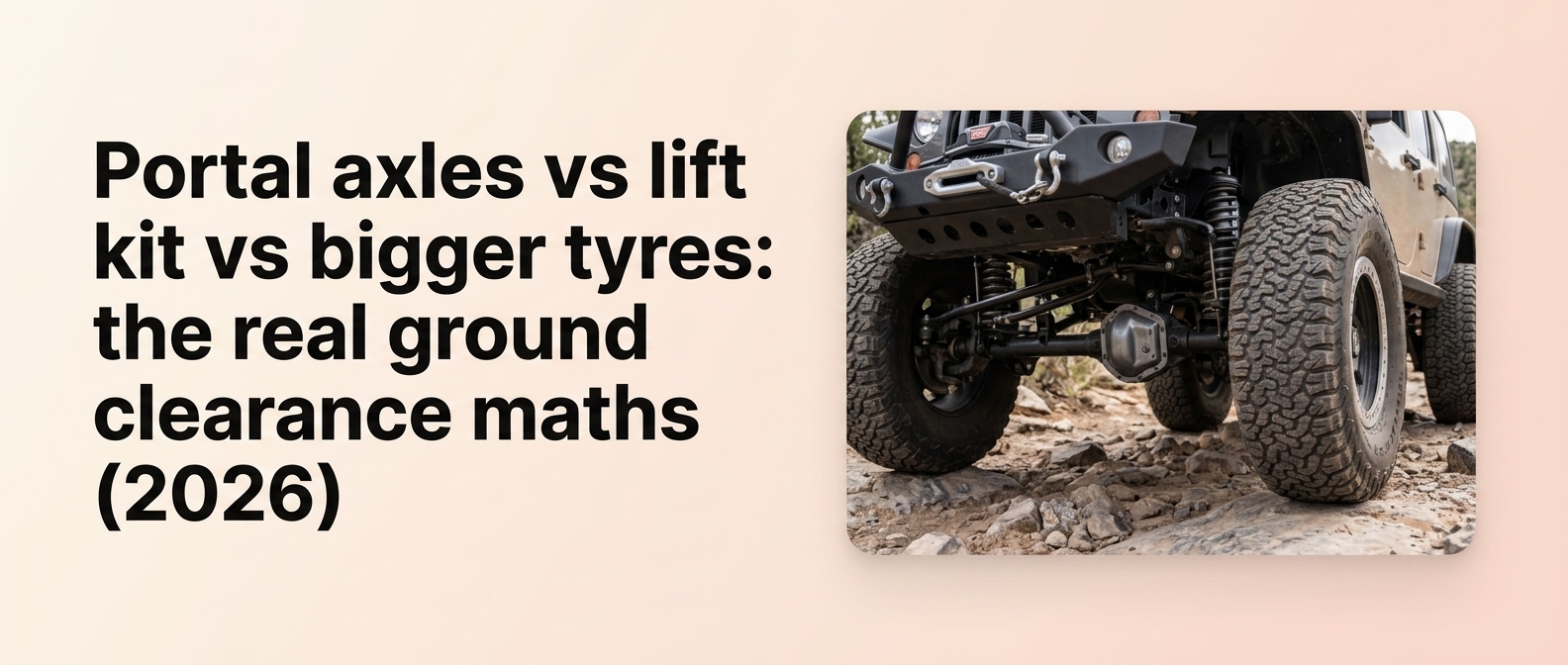
There is a stubborn myth in the off-road world that a 4-inch lift equals 4 inches of extra ground clearance. It usually doesn’t. Lift kits, bigger tyres, and portal axles do not raise the same parts of your vehicle – a suspension lift raises the body and frame relative to the axle, bigger tyres raise the differential by only half their diameter increase, and portal axles raise the differential and axle housing directly by their hub offset. This guide gives you the actual maths, worked examples, and a neutral decision framework so you can choose based on which part of your rig is really the lowest.
Key takeaways
- Portal axles raise the differential and axle housing directly via hub offset, so they change the part that most often hits obstacles.
- A suspension lift raises the body and frame relative to the axle, not the differential itself.
- Bigger tyres add differential clearance equal to only half the tyre diameter increase.
- Most road-going 4×4 portal axle kits add roughly 3.5–4.0 inches of true differential clearance, with some heavy-duty systems advertising more.
- Portal axles carry the highest cost, added unsprung weight, and extra geared-hub maintenance of the three options.
- The right upgrade depends on which point on your vehicle is actually the lowest and making contact off-road.
What is a portal axle?
A portal axle is an axle system with a geared hub – a portal box – at each wheel that positions the wheel centre lower than the axle centreline. This raises the differential and axle housing for more ground clearance while adding final-drive gear reduction at each hub. It changes the part of your vehicle that most commonly drags on obstacles.
How the portal box and geared hub work
The power flow through a portal hub is straightforward once you picture the gears:
- The axle shaft enters the top of the portal box at the original axle centreline.
- A gearset inside the box transfers power downward to a lower output.
- The wheel mounts to that lower hub, so the wheel centre sits below the axle centreline.
Because the wheel centre drops, the entire axle housing and differential rise relative to the ground by the vertical distance between the two centrelines – the hub offset. Common road-going hub ratios sit around 1:1.35, meaning the gear reduction happens right at the hub.
How portal axles differ from a standard axle layout
On a standard axle, the differential, hub, and wheel centre all share one centreline, so the diff can only be raised by fitting taller tyres. A portal axle deliberately drops the hub below the axle centreline. That single change delivers two things at once: added differential clearance equal to the hub offset, and final-drive gear reduction that increases torque at the wheel.
What “ground clearance” actually means off-road
Ground clearance is not a single number. Lift height describes how high the body or suspension sits, while true differential ground clearance is the distance under the lowest axle or differential point – and these are not the same measurement. Confusing the two is why many builds look dramatically taller but still drag the diff on the same rock.
Find your lowest point first
Before comparing upgrades, identify what actually contacts obstacles. The usual candidates are:
- Differential pumpkin
- Axle tubes
- Skid plates
- Crossmembers
- Control arm and spring mounts
- Frame rails
If you keep hitting the diff pumpkin, raising the body will not help. If you catch skid plates or frame rails, chassis height matters more. The best upgrade is the one that lifts your specific lowest point.
Differential clearance vs breakover, approach, and departure angles
Differential clearance is a vertical distance under the axle. Breakover, approach, and departure angles describe how the chassis clears ridges, crests, and steep entries and exits. They are related but distinct. Bigger tyres help all-around chassis height and angles; a suspension lift improves chassis height and breakover by raising the frame and skid plates; portal axles directly raise the axle and differential.
Do lift kits increase differential clearance?
No. A suspension lift raises the body, frame, and suspension mounting points relative to the axle, but it does not raise the differential housing itself. If the differential is your lowest contact point, a suspension lift alone will not solve it – the diff height is set by tyre radius, not by ride height.
What a lift does improve is real and worth having:
- More uptravel and downtravel room for articulation
- Wheel-well clearance for larger tyres
- Chassis clearance and breakover angle by moving the frame and skid plates further from the ground
So a lift is far from useless – it just solves chassis and fitment problems, not diff clearance.
Don’t confuse these two measurements: body and frame height are what a lift changes; differential clearance is what stays the same until you fit taller tyres or portals.
How much clearance do bigger tyres really add?
Bigger tyres raise the differential by only half the tyre diameter increase. Going from a 33-inch to a 35-inch tyre adds roughly 2 inches of diameter, which lifts the differential by about 1 inch. Because the axle sits at the hub centre, only the radius increase – half the diameter – reaches the ground under the diff.
Why tyre upgrades add only half the diameter increase
The differential sits at the hub centreline, which is the centre of the tyre. When you increase tyre diameter, the centre of the wheel rises by the radius increase, not the full diameter increase. Radius is half of diameter, so a 2-inch larger tyre lifts the axle centre – and therefore the diff – by about 1 inch.
Quick math: diameter increase ÷ 2 = differential clearance gain.
Worked examples – 33→35, 35→37, 37→40
One important caveat: tyre labels are marketing numbers. Most off-road tyres measure about 0.5–1.5 inches smaller than their nominal size, so measure your actual diameters or check manufacturer specs. Even with real dimensions, the half-the-diameter rule holds.
| Tyre change (nominal) | Diameter increase | Radius increase | Approx. diff clearance gain |
| 33 → 35 | ~2 in | ~1 in | ~1 in |
| 35 → 37 | ~2 in | ~1 in | ~1 in |
| 37 → 40 | ~3 in | ~1.5 in | ~1.5 in |
How much clearance do portal axles add?
Portal axles add clearance roughly equal to their hub offset – commonly around 3.5 to 4.0 inches on road-going 4×4 kits – because they raise the axle and differential directly rather than relying on suspension height or tyre radius alone. Some heavy-duty platforms advertise more, and effective gains can be larger where the previous lowest point was a bracket that also moves up with the axle.
The mechanics are direct: the vertical distance between the original and new hub centrelines becomes added clearance at the axle housing, assuming tyre radius is unchanged. On some platforms, total effective clearance at the lowest static point can exceed the raw hub offset because spring perches, mounts, and brackets all rise with the axle assembly.
The second benefit is gearing. Because the reduction happens at the hub, portal axles also shorten your overall gearing – a 4.10 axle paired with a 1.35 portal ratio yields roughly a 5.54 effective ratio, increasing crawl ratio and wheel torque by around 35%. Exact numbers depend on the vehicle, tyre size, and which component is actually your lowest point.
Portal axles vs lift kit vs bigger tyres: the real maths
For differential clearance specifically, portal axles usually win. They can raise the diff several inches directly, while bigger tyres add only half the diameter increase and a suspension lift does not raise the diff at all. The right answer still depends on your lowest contact point, but the maths is not close when the diff is the problem.
What actually increases?
| Factor | Portal axles | Suspension lift | Bigger tyres |
| Differential clearance | Raised directly (~3.5–4 in) | Not raised | Raised (½ diameter) |
| Axle tube height | Raised | Not raised | Raised (½ diameter) |
| Body/frame height | Raised with axle assembly | Raised | Slight (via radius) |
| Wheel-well room | Often improved at ride height | Increased | Reduced |
| Breakover angle | Improves | Improves | Improves slightly |
| Steering/geometry impact | Track width, scrub radius | Driveline/CV angles, caster | Moderate |
| Cost tier | Highest | Moderate | Low–moderate |
| Maintenance impact | High (geared hubs) | Low | Low |
Clearance math worked examples
The scenarios below use a stock rig on 33s as the baseline. Notice how a lift changes chassis height but leaves the diff untouched, while tyres and portals both move the diff – just by very different amounts.
| Setup | Diff clearance gain | Body/frame lift | Notes |
| Stock 33s | baseline | baseline | – |
| 2″ lift only | ~0 in | ~2 in | Diff unchanged |
| 33→35 tyres | ~1 in | ~1 in | Half diameter |
| 2″ lift + 35s | ~1 in | ~3 in | Combined |
| Portals only | ~3.5–4 in | ~3.5–4 in | Hub offset |
| Portals + 37s | ~5.5–6 in | ~5.5–6 in | Compounded |
Quick math: A 2-inch lift does not raise the diff. A tyre 2 inches larger in real diameter raises the diff about 1 inch. A 4-inch portal offset raises the diff about 4 inches.
What each option changes beyond clearance
Clearance is only part of the decision. Each path changes gearing, geometry, weight, and maintenance in different ways, and those trade-offs often decide which upgrade actually suits your rig.
Gearing, crawl ratio, and wheel torque
Portal axles add final-drive gear reduction at the hub, shortening your overall gearing and increasing torque at the tyre – which helps offset the taller effective gearing that larger tyres create. Bigger tyres do the opposite: they lengthen gearing, reduce torque at the contact patch, and can dull crawl ratio unless you re-gear the differentials. Lift kits are gearing-neutral; they change geometry and height, not final-drive ratios.
Driveline, CV angles, and steering geometry
Most portal kits increase track width and alter scrub radius, because the hub boxes move the wheel mounting point outward and downward; the exact change is brand- and platform-specific. Suspension lifts mainly affect driveline and CV angles, caster, and steering linkage geometry – the taller the lift, especially on IFS, the more carefully those angles must be managed. Bigger tyres change scrub radius and steering effort more modestly.
Unsprung weight, centre of gravity, and articulation
Portal axles add unsprung weight at each corner, which affects ride quality and high-speed handling. A suspension lift raises the centre of gravity, which matters on fast or off-camber terrain. Bigger tyres add rotational mass that affects acceleration and braking. None of these is disqualifying, but they explain why the “best” clearance upgrade is not always the best overall choice.
Maintenance and serviceability
Portal hubs run a sealed gearset in an oil bath, so they require periodic fluid checks, fluid changes, and seal inspections – especially after heavy off-road use or water crossings. Many manufacturers recommend servicing on a similar cadence to differential maintenance, but exact intervals and fluid specifications are kit-specific. Lift kits and tyres, by contrast, carry very low ongoing maintenance.
Which upgrade makes sense for your use case?
There is no universal winner. The correct upgrade depends on your terrain, budget, drivability tolerance, and – most of all – which part of your rig is actually contacting obstacles. Pairing the right clearance upgrade with traction hardware like a differential locker often matters just as much for real-world capability.
Mild trails and greenlaning
For ruts, small rocks, and forest roads, a modest tyre upsize plus possibly a small 2-inch lift for chassis clearance and tyre room is usually enough. Portals are generally overkill here.
Overlanding and expedition builds
Long-distance travel with added armour, a roof tent, and gear rewards a quality suspension lift paired with larger tyres for chassis height and load handling. Portals become relevant only if the build regularly drags the diff on technical sections.
Rock crawling
Frequent diff hang-ups, big ledges, and boulders are where portal axles become rational. They maximise differential clearance and add crawl gearing, often combined with 37–40-inch tyres and a moderate lift – the use case that justifies their cost. Many serious crawlers also add a diff locker to keep both wheels driving when one lifts off an obstacle.
High-speed desert and mixed on-road
Stability, low unsprung weight, and predictable handling favour a well-tuned suspension lift and tyre package. Portals’ added unsprung weight and steering changes are often a downside in this environment.
Budget-limited and daily-driven rigs
If the rig lives mostly on-road with occasional trails, fit tyres first, then a small lift if you need fitment or chassis clearance. Portals are usually a future, staged goal for highly specialised builds. You can browse the full range of off-road accessories to plan a staged build that fits your budget.
Are portal axles worth it in 2026?
Portal axles may be worth the cost for builds that regularly hit the differential or need major clearance without extreme lift. Value depends on terrain, tyre goals, drivetrain limits, maintenance tolerance, and budget rather than on any universal “best upgrade” claim.
On cost, keep the tiers in perspective. Complete portal axle packages for full-size 4x4s typically fall into the low-five-figure range per vehicle before installation, with some Jeep-focused packages cited around $17,000. UTV portal kits are commonly $2,500–$5,000+, traditional lift kits span roughly $500–$3,000, and a set of larger tyres often lands in the low- to mid-four-figure range depending on size and brand. Frame the decision as relative tiers, not a single fixed number.
There is also a modern wrinkle: many late-model 4x4s with camera- and radar-based driver assistance may need ADAS, ESC, or alignment checks after significant ride-height or track-width changes, because those sensors assume factory geometry. Check your vehicle’s service guidance before major suspension or portal work.
Engineering perspective – why portal hub quality matters
A portal hub is effectively a small, high-load gearbox at each wheel, and its durability is decided long before it bolts on. As a manufacturer of aluminium die casting products, precision steel parts, and precision machined components, Lamda Components Pvt. Ltd. approaches portal hubs through a tolerances-and-sealing lens rather than a marketing one.
Several factors decide how long a portal hub lasts:
- Gear alignment and backlash – any tolerance stack-up in the compact gearset is magnified at the wheel, driving noise and wear.
- Bearing support – wheel and gear loads pass through the hub bearings, so accurate seating and quality bearings are essential.
- Sealing and pressure management – hubs must be sealed against water and grit while breathing correctly to avoid oil leaks and seal blow-out.
- Housing integrity and lubrication – precise casting or fabrication, correct heat treatment, and clean lubrication paths keep the gears alive under impact loads.
A “bolt-on” portal still demands real engineering. Have a portal or precision component manufacturing requirement? Contact us.
Vehicle-specific portal axle notes
Portal fitment is most mature on solid-axle platforms, with emerging kits for IFS trucks and factory portals on a few specialist vehicles. Each platform carries unique constraints around CV angles, steering geometry, brake packaging, and legal approvals, so always consult system-specific documentation. If you run a compact 4×4, our Jimny portal axle kits are engineered around these exact constraints.
Jeep Wrangler (JK/JL)
Portal axle packages for solid-axle Wranglers are widely available from specialists, built around Dana 44/60-style housings and factory link geometry. They target rock-crawling and extreme builds, often paired with 37–40-inch tyres.
Toyota Tacoma / 4Runner
Dedicated portal kits exist for these IFS-front platforms, typically attaching to factory knuckles or control-arm mounts. Constraints include front CV angles, tie-rod strength, and clearance to upper control arms and fenders.
Unimog
The Unimog is the classic example of factory portal axles, where portals are integral to the design rather than aftermarket. It demonstrates the durability and clearance potential of portals in OEM form.
Ineos Grenadier and newer platforms
Manufacturer collaborations have showcased Grenadier-specific portal builds integrated with its ladder frame and solid axles. Availability is limited, and fitment must account for OEM stability and homologation.
Frequently asked questions
What is a portal axle?
A portal axle uses a geared hub, or portal box, at each wheel that places the wheel centre below the axle centreline. This raises the differential and axle housing directly for more ground clearance and adds final-drive gear reduction at the hub, increasing wheel torque.
How much lift do portal axles add?
Most road-going 4×4 portal kits add roughly 3.5–4.0 inches of true differential clearance, equal to their hub offset, with some heavy-duty systems advertising more. The exact figure depends on the vehicle, tyre size, and which component was previously your lowest point.
Do portal axles increase ground clearance more than bigger tyres?
Yes, for differential clearance. Portals raise the diff by their full hub offset – commonly 3.5–4 inches – while bigger tyres raise it by only half the diameter increase, typically around 1 inch per two-size step. Portals change the axle height directly.
Do lift kits raise the differential?
No. A suspension lift raises the body, frame, and suspension mounts relative to the axle, but the differential height is set by tyre radius. A lift improves chassis clearance, breakover angle, and wheel-well room for larger tyres, not diff clearance.
How much clearance do bigger tyres add?
Bigger tyres add roughly half their diameter increase at the differential. Moving from a 33-inch to a 35-inch tyre adds about 2 inches of diameter and around 1 inch of diff clearance. Most tyres measure smaller than their labels, so verify real diameters.
What are the disadvantages of portal axles?
Portal axles carry the highest cost of the three options, add unsprung weight at each corner, and require geared-hub maintenance with periodic fluid changes and seal inspections. They also change track width and scrub radius and involve more complex, platform-specific fitment.
Are portal axles worth the cost?
They are worth it for builds that regularly drag the differential or need major clearance without extreme lift, especially rock crawlers. If your lowest contact points are chassis or body, tyres and a suspension lift are usually the smarter, lower-cost path.
What is the difference between lift height and true ground clearance?
Lift height is how high the body or suspension sits above the axle. True differential ground clearance is the distance under the lowest axle or diff point. A rig can gain lift height while its differential clearance stays exactly the same.
